



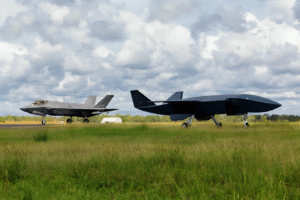
Boeing [NYSE: BA] and the Royal Australian Air Force (RAAF) have successfully completed a series of demonstrations validating the operational effectiveness of the MQ-28 Ghost Bat Collaborative Combat Aircraft (CCA). The missions, finalized in early June—four months ahead of schedule—confirmed the platform’s ability to support and enhance existing crewed aircraft operations.

The MQ-28 Ghost Bat is a pioneering autonomous capability designed to execute combat tasks while reducing risks to crewed platforms. Built as part of Australia’s push into next-generation defense technologies, the program underscores the growing role of Collaborative Combat Aircraft (CCAs) in future air power.
Operational Details
The demonstrations, defined by the RAAF, validated key capabilities including:
-
Autonomous behaviours and mission execution
-
Multi-ship operations to increase combat mass
-
Deployment operations to RAAF Base Tindal
-
Integration with an E-7A Wedgetail airborne early warning and control aircraft
-
Data fusion and sharing between multiple MQ-28 aircraft and crewed platforms
To date, the uncrewed MQ-28 platforms have logged 150 hours of live testing and more than 20,000 hours of virtual testing.
Economic Impact
The accelerated success of the MQ-28 program not only strengthens Australia’s defense readiness but also highlights Boeing’s role as a key defense and aerospace partner. The program supports domestic industry, allied collaboration, and global defense supply chains, with potential long-term economic benefits from production and export opportunities.
Strategic Significance
According to Glen Ferguson, MQ-28 Global Program Director, the demonstrations validated the first four steps in the air combat chain: find, fix, track, and target. With this milestone achieved ahead of schedule, Boeing and the RAAF are now preparing for the next phases—engage and assess—including an air-to-air weapon test in late 2025 or early 2026.
The capabilities will be incorporated into Block 2 aircraft currently in production, forming the foundation of the RAAF’s initial operational capability and providing a model for allied partners considering CCA adoption.

 Share your work with UNI Network Magazine. Upload your PDF below.