



The latest Y Combinator W26 Demo Day has sparked widespread attention across the global startup ecosystem, with early indicators pointing to one of the strongest cohorts in the accelerator’s history. Within hours of the event, multiple startups reported exceptional growth metrics, funding milestones, and market validation – signaling a broader shift in startup performance standards.
Unprecedented Growth and Early Traction
One of the most striking highlights from the W26 batch is that 14 startups have already surpassed $1 million in Annual Recurring Revenue (ARR) – a benchmark typically associated with more mature companies. This level of traction at such an early stage reflects not only strong product-market fit but also the increasing efficiency of AI-driven business models.
 Among the standout performers is Pocket, which reportedly shipped over 30,000 hardware units within five months, achieving an impressive $27 million annualized run rate alongside rapid month-over-month growth. Such metrics are rarely seen at the seed stage, positioning these startups closer to Series B-level performance.
Data-Driven Validation and Batch Strength
According to insights from Rebel Fund, a data-driven venture firm that has analyzed YC startups since 2013, approximately 35% of W26 companies rank in the top 20% of all startups evaluated historically. This marks a significant deviation from previous cohorts, where only a handful of companies typically reached such rankings.
Rather than a concentration of outliers, the W26 batch demonstrates a system-wide elevation in quality, suggesting that the entire distribution of startups has shifted upward. This trend highlights the growing maturity of founders, improved access to AI tools, and stronger pre-YC preparation.
 AI Dominance and Sectoral Innovation
Artificial Intelligence continues to dominate the startup landscape, with a significant portion of W26 companies focused on AI agents, automation platforms, and vertical-specific intelligence systems.
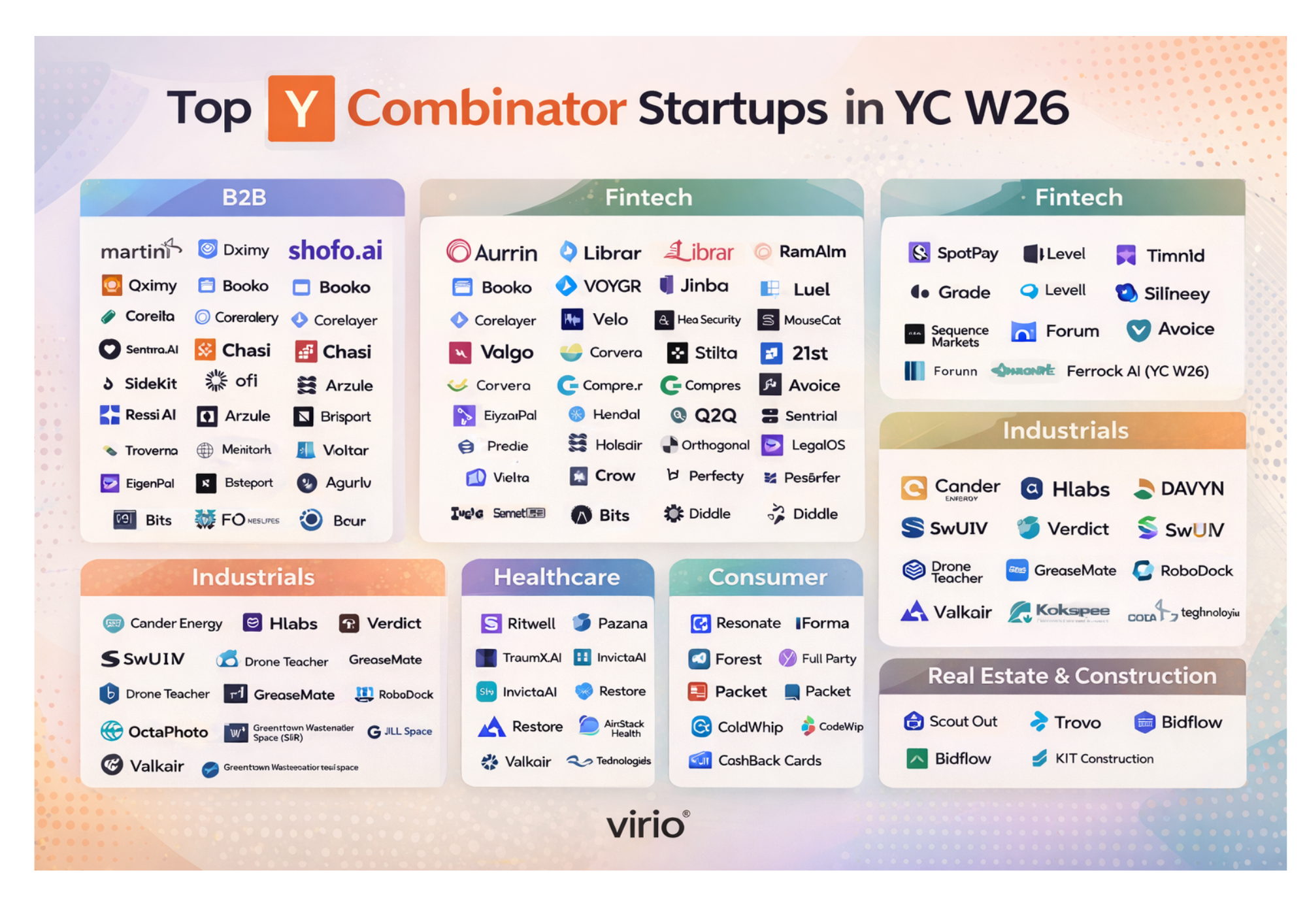
Startups such as 21st and Zatanna are building infrastructure and APIs for AI agents, while OpenSpec has gained traction with a widely adopted specification framework for coding agents. In healthcare, Beacon Health secured one of the largest raises in the batch, underlining continued investor confidence in AI-driven medical solutions.
Other startups are pushing boundaries across industries:
- Fenrock AI is transforming banking back-office operations
- Mango Medical is advancing surgical planning through agentic systems
- Human Archive is building one of the largest multimodal robotics datasets globally
This wave of innovation reflects a broader shift toward agentic AI systems capable of autonomous decision-making and execution.
 Geographic Concentration and Hardware Resurgence
Another notable trend is the geographic concentration of startups, with approximately 73% of the batch based in San Francisco—the highest in YC history. This clustering suggests a renewed importance of proximity to talent, capital, and AI research hubs.
Additionally, 14% of the cohort is focused on hardware innovation, ranging from lunar infrastructure projects to advanced robotics components. Companies like GRU Space and HLabs exemplify a renewed interest in deep-tech and physical systems, complementing the software-heavy AI ecosystem.
Strategic and Economic Implications
The performance of the W26 batch signals a broader transformation in the startup ecosystem. Faster scaling cycles, early revenue generation, and AI-native architectures are redefining expectations for early-stage companies.
For investors, this shift may lead to compressed funding timelines and increased competition for high-performing startups. For founders, the bar has been significantly raised—requiring stronger execution, clearer differentiation, and rapid validation.
Most importantly, the success of W26 underscores the emergence of a new generation of startups that are built to scale from day one, leveraging AI not just as a tool, but as a foundational layer.
Conclusion
The Y Combinator W26 Demo Day represents more than just a successful batch—it signals a paradigm shift in how startups are built, scaled, and evaluated. With record-breaking traction, data-backed validation, and a strong focus on AI innovation, W26 may well redefine benchmarks for future cohorts.


 Share your Details for subscribe