



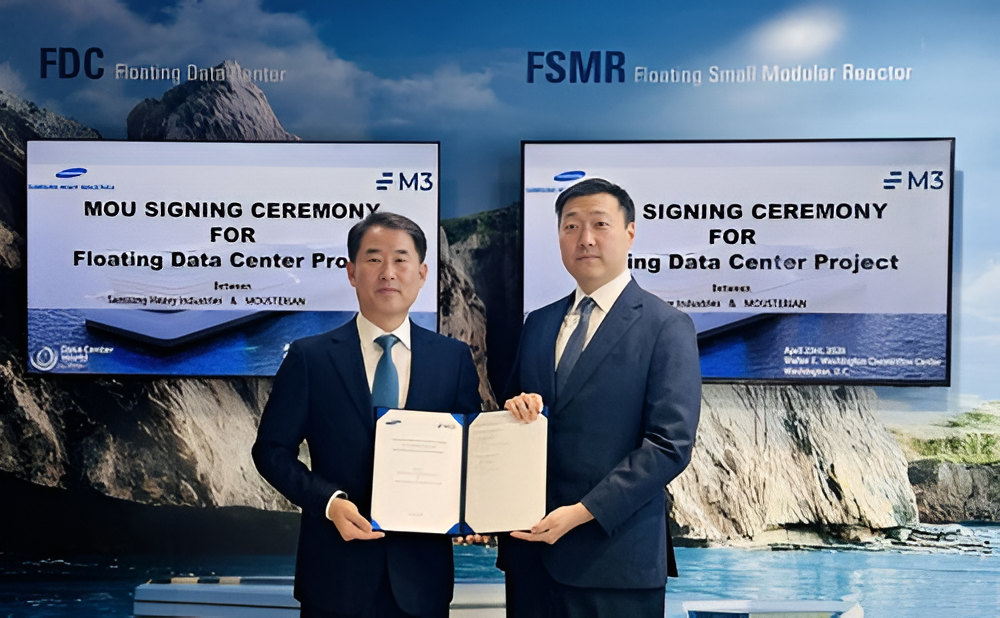
Mousterian Corporation has signed a Memorandum of Understanding (MoU) with Samsung Heavy Industries to jointly develop floating data center (FDC) projects. The partnership targets growing global demand for hyperscale and AI compute infrastructure, with initial focus on the United States.
Rising Demand for AI Infrastructure
The agreement comes amid surging demand for data center capacity driven by artificial intelligence workloads and cloud computing. Traditional land-based infrastructure often faces challenges such as land constraints, power availability, and lengthy permitting timelines.
Floating data centers—deployed near existing power generation assets- are emerging as a viable alternative, offering faster deployment and access to otherwise underutilized energy resources.

Operational Details: Division of Responsibilities
Under the collaboration, Mousterian Corporation will lead project development, site selection, tenant acquisition, and overall delivery. Meanwhile, Samsung Heavy Industries will contribute its large-scale maritime engineering, fabrication, and shipbuilding expertise.
This division leverages Mousterian’s experience in floating data center design and ecosystem partnerships alongside Samsung’s global scale in constructing complex offshore assets.
Economic and Technological Impact
The partnership aims to unlock “stranded” power capacity—energy resources that are not easily accessible to conventional data center developments. By positioning floating facilities adjacent to these sources, the companies expect to significantly reduce project timelines while enabling gigawatt-scale deployments.
This model could reshape digital infrastructure economics by lowering barriers to entry and enabling faster scalability for hyperscale operators and AI-driven enterprises.
Strategic Significance: Convergence of Maritime and Digital Infrastructure
The collaboration highlights a growing convergence between maritime engineering and digital infrastructure. According to Min Suh, the partnership validates floating data centers as an institutional-grade asset class capable of delivering large-scale capacity efficiently.
Similarly, Ahn Young-kyu emphasized that floating data centers represent a new business model for shipbuilding, extending its capabilities into high-growth digital markets while aligning with eco-friendly energy solutions.


 Share your Details for subscribe