


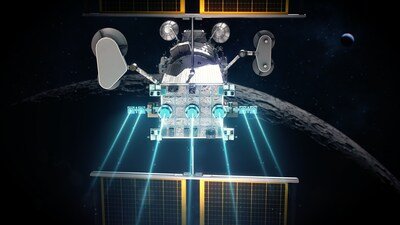
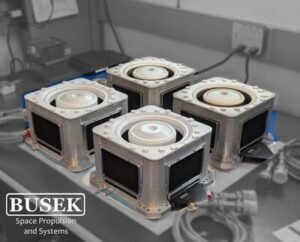
NATICK, Mass., Sept. 15, 2025 — Busek Co. Inc., a U.S. leader in electric propulsion, has successfully delivered its BHT-6000 Hall effect thrusters for NASA’s Lunar Gateway in partnership with Maxar Space Systems. The thrusters form a critical part of the Solar Electric Propulsion (SEP) subsystem of the Power and Propulsion Element (PPE), enabling efficient maneuvering in deep space.
Advancing Deep Space Propulsion
The PPE, built by Maxar Space Systems, integrates four Busek BHT-6000 thrusters, propellant storage, and high-power control electronics. Combined with three 12kW engines, the SEP system is 30% more powerful than any previously flown, making it one of the most advanced electric propulsion systems in operation.
Enabling Artemis Missions
Operating in a Near Rectilinear Halo Orbit (NRHO) around the Moon, the PPE will provide power, maneuvering, attitude control, and communications for Gateway—NASA’s planned lunar outpost. This capability underpins the Artemis program, which seeks not only to return astronauts to the Moon but also to pave the way for crewed Mars missions.
Innovation for Multiple Missions
Originally developed for geostationary satellites, Busek’s thruster technology has evolved to meet the stringent demands of human-rated deep space missions. “With the first BHT-6000 deliveries complete, we can now offer the same solution for communications satellites, orbital tugs, life-extension vehicles, and future space stations,” said Vlad Hruby, President and Founder of Busek.

Partnership and Legacy
“This system represents the state of the art in high-power propulsion,” added Taylor Winkelmann, Maxar Space Systems’ PPE Program Manager, highlighting the collaboration that brought the technology from concept to delivery. Managed by NASA’s Glenn Research Center, the PPE is central to Gateway’s role as the staging hub for future exploration.

 Share your work with UNI Network Magazine. Upload your PDF below.