


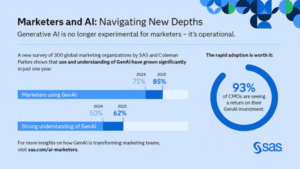
A new global study by SAS and Coleman Parkes has revealed that Generative AI (GenAI) has moved from hype to essential infrastructure, with 85% of marketing teams actively deploying the technology—a significant jump from 75% in 2024. The research underscores how marketing leaders are no longer experimenting with GenAI but embedding it into operations for measurable ROI.

From Experimentation to Essential Marketing Infrastructure
According to the Marketers and AI: Navigating New Depths report, 93% of CMOs and 83% of marketing teams deploying GenAI report positive ROI. Compared to 2024, understanding of GenAI’s business impact has also risen sharply—62% of marketers now report a strong grasp of the technology, up from 50%.
Operational Details: How GenAI Is Being Used
The study highlights core applications: chatbots (62%), content generation (45%), and trend analysis (36%). Emerging use cases include synthetic data (18%), small language models (12%), and digital twins (5%). GenAI is credited not just with efficiency gains but also with improved personalization (94%), predictive accuracy, and customer loyalty.
 Economic Impact: ROI Beyond Cost Savings
Marketers are seeing benefits that extend beyond time and cost reduction. 91% cite efficiency in processing large datasets, while 90% confirm operational savings. Nearly nine in ten organizations report increased sales performance and customer engagement, confirming GenAI’s role as a revenue enabler rather than just a support tool.
Strategic Significance: Investments Through 2026
GenAI adoption is enabling autonomous, AI-driven marketing strategies. The study found that 93% of marketing teams are budgeting for GenAI through 2026, cementing its role as a present-day imperative. SAS CMO Jenn Chase emphasized that GenAI is “no longer a pilot project but a core driver of marketing transformation.”
Source Attribution
Source: SAS Press Release

 Share your work with UNI Network Magazine. Upload your PDF below.