



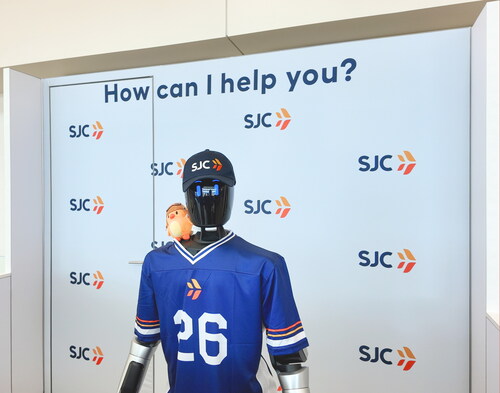
San José Mineta International Airport has introduced an AI-powered humanoid robot named “José,” developed by IntBot. The deployment marks a significant step in integrating advanced artificial intelligence into public infrastructure, enhancing passenger experience through real-time, multilingual interaction.
Airports as Innovation Hubs
Located in the heart of Silicon Valley, San José Mineta International Airport has consistently served as a testing ground for emerging technologies. The introduction of José reflects a broader trend of using AI and robotics to improve customer service, accessibility, and operational efficiency in high-traffic environments.
The initiative also aligns with the city’s strategy to showcase innovation ahead of major global events like the FIFA World Cup, which is expected to bring a surge of international travelers.
Operational Details: Real-Time AI Assistance
Stationed at Terminal B, Gate 24, José is designed to assist travelers by greeting them, answering queries, and providing real-time information in over 50 languages. The robot leverages advanced AI capabilities such as contextual reasoning, natural interaction, and real-world perception.
This enables seamless operation in complex environments like airports, where passenger needs vary widely and require quick, accurate responses.
Technology and Innovation Leadership
Lei Yang, CEO of IntBot, emphasized that the robot represents a new category of socially intelligent AI systems capable of understanding human intent and behavior in dynamic settings.
The platform combines multimodal perception with closed-loop interaction systems, allowing it to continuously improve performance through real-world deployment data.
Public Sector Collaboration and Vision
City leadership has highlighted the deployment as part of a broader push toward responsible innovation. Officials see the robot as a tool to enhance service delivery while reinforcing San José’s reputation as a global technology hub.
Airport authorities are also exploring how such technologies can improve passenger flow, accessibility, and overall travel convenience.
Economic and Strategic Impact
The pilot program, scheduled for four months, is expected to provide valuable insights into how humanoid robots can be deployed at scale in public spaces. Successful implementation could pave the way for wider adoption across airports, hotels, and other service industries.
By blending AI with physical interaction, the initiative demonstrates the growing role of robotics in transforming customer-facing operations.
Strategic Significance: Advancing Human-Robot Collaboration
The launch of José highlights the increasing convergence of artificial intelligence and robotics in everyday environments. As airports evolve into smart infrastructure hubs, such innovations are set to redefine how travelers interact with services.
For IntBot, this deployment represents a critical milestone in scaling socially intelligent robots, while for San José, it reinforces its leadership in driving real-world applications of emerging technologies.


 Share your Details for subscribe