


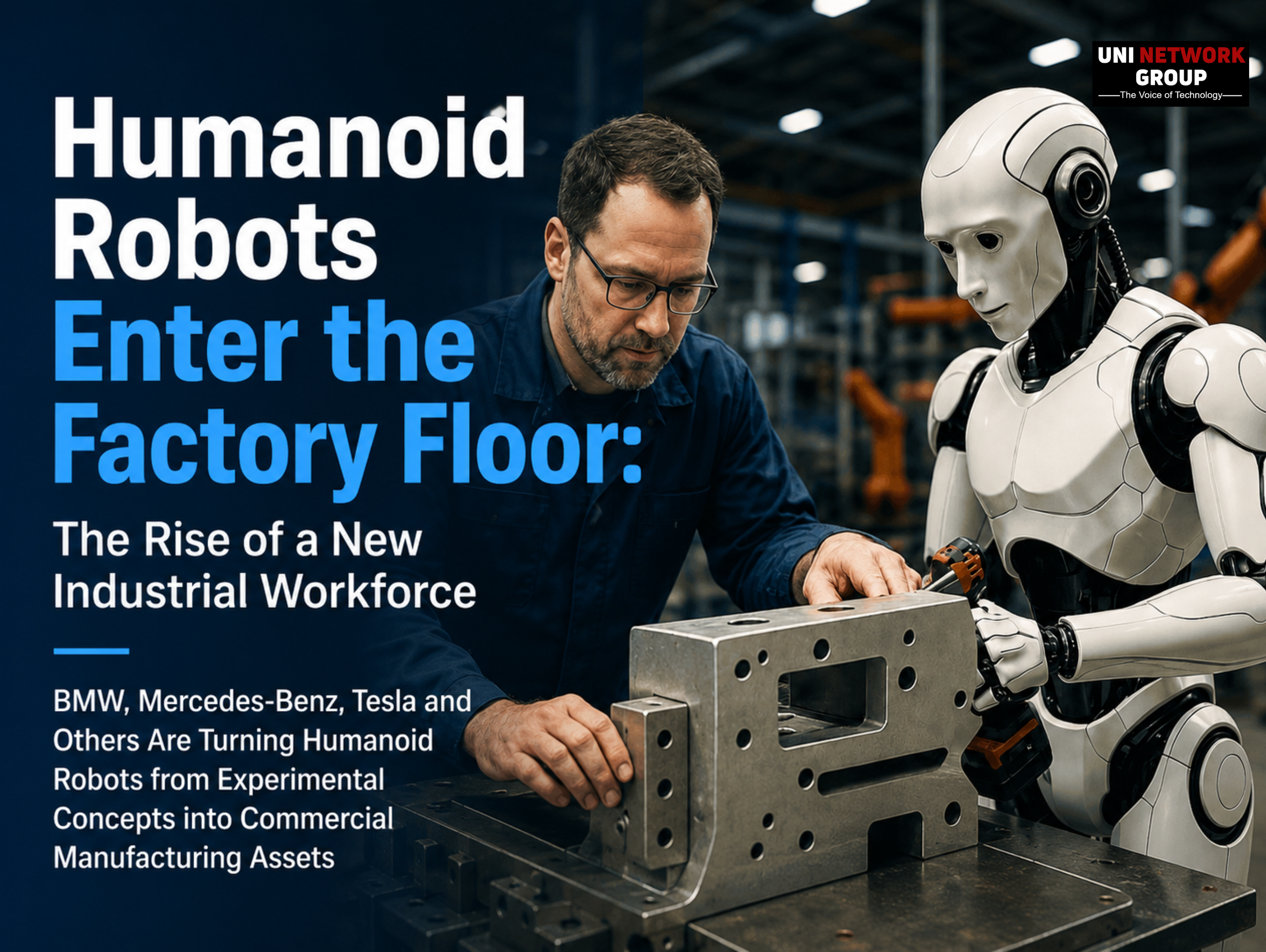
For decades, humanoid robots existed largely as demonstrations of technological possibility—impressive prototypes showcased at trade shows and research laboratories but rarely seen in real production environments. In 2026, that narrative is rapidly changing.
Across automotive manufacturing plants in the United States and Europe, humanoid robots are now performing meaningful industrial tasks ranging from parts handling and assembly support to logistics, quality inspection, and battery manufacturing. What was once considered a futuristic concept is evolving into a commercially viable workforce solution, driven by advances in artificial intelligence, robotics hardware, machine vision, and industrial automation.
Leading manufacturers including BMW, Mercedes-Benz, and Tesla are actively deploying humanoid systems on factory floors, signaling the beginning of a new chapter in industrial automation.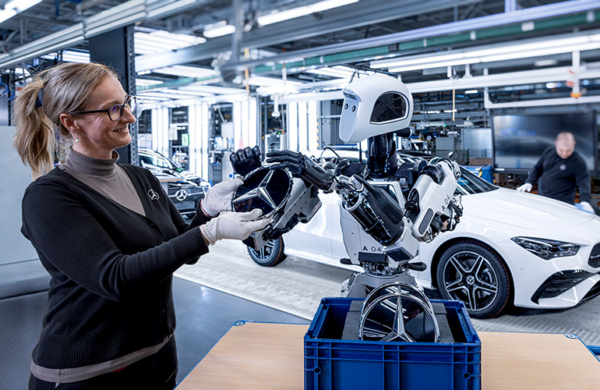
From Research Labs to Production Lines
The most significant shift occurring in the humanoid robotics industry is the transition from experimental pilots to commercial deployment.
Automotive manufacturers are increasingly evaluating humanoids not as technological showcases but as operational assets capable of addressing labor shortages, repetitive work, and production efficiency challenges. Modern humanoid systems are designed to operate in environments originally built for human workers, allowing companies to introduce automation without redesigning entire production facilities.
This capability is particularly attractive for manufacturers seeking flexibility in operations while avoiding the significant capital expenditure associated with traditional fixed automation systems.
BMW’s Commercial Deployment Signals Industry Maturity
Among the most closely watched deployments is BMW’s implementation of Figure robots at its Spartanburg facility in South Carolina.
The program has demonstrated how humanoid robots can support automotive production by handling parts movement, assembly assistance, and inspection tasks. The deployment represents one of the industry’s first examples of humanoid robots operating under a commercial business model rather than a research-focused pilot.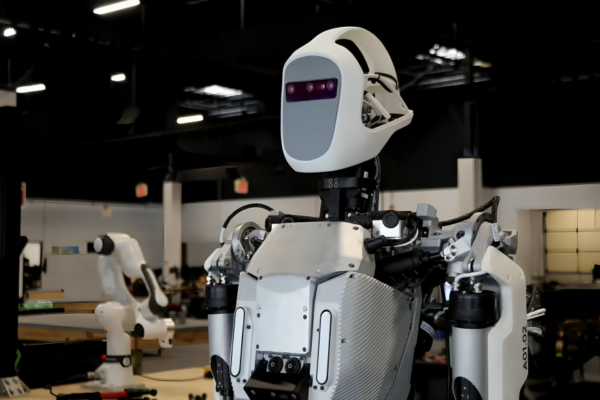
The success of such initiatives is encouraging manufacturers to evaluate where humanoids can create measurable value across existing production workflows.
Mercedes-Benz Focuses on Intra-Logistics and Material Flow
While some manufacturers are using humanoids directly on assembly operations, Mercedes-Benz has adopted a logistics-centered approach.
The company’s deployment of Apptronik’s Apollo robot focuses on transporting assembly kits, moving materials between workstations, and supporting production logistics. These applications address one of manufacturing’s most persistent inefficiencies—human operators spending significant portions of their shifts walking between stations rather than performing value-added tasks.
By automating material movement and kit delivery, manufacturers can improve productivity while allowing employees to focus on more complex responsibilities.
The Growing Importance of Battery and EV Manufacturing
Electric vehicle production is emerging as one of the most promising areas for humanoid deployment.
Battery assembly involves repetitive processes, strict safety requirements, and demanding ergonomic conditions. Humanoid robots offer a flexible solution capable of operating within existing workstations while handling complex components and materials.
As global EV production continues to expand, manufacturers are increasingly exploring humanoids as a scalable automation solution capable of supporting future battery manufacturing requirements.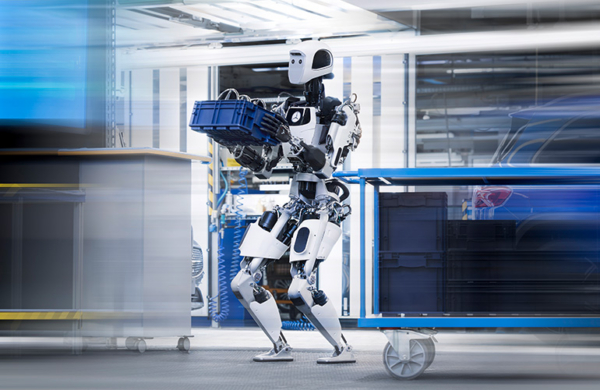
Five Key Applications Driving Adoption
Current deployments across automotive facilities reveal several common use cases where humanoid robots are demonstrating the strongest value proposition:
- Parts Handling and Assembly Support : Robots assist with picking, positioning, and placing components in production environments where flexibility is required.
- Intra-Logistics Operations : Humanoids transport kits, materials, and components between workstations and production areas.
- Quality Inspection : Advanced vision systems enable robots to perform inspection tasks with consistency and accuracy.
- Machine Tending : Humanoids can load and unload manufacturing equipment designed around human workspaces.
- Battery and Component Manufacturing : Electric vehicle production environments provide significant opportunities for flexible robotic assistance.
These applications represent the foundation of the first wave of industrial humanoid adoption.
Artificial Intelligence Powers the Next Generation of Robotics
A defining characteristic of modern humanoids is their reliance on AI-driven learning systems.
Unlike traditional industrial robots that require extensive programming, new humanoid platforms increasingly use imitation learning and teleoperation. Human operators demonstrate tasks, allowing robots to learn workflows through observation and repetition.
This approach significantly reduces deployment complexity and accelerates adaptation to new manufacturing environments.
As AI models continue to improve, robots are expected to become increasingly autonomous while maintaining the flexibility required for dynamic production settings.


 Share your Details for subscribe