


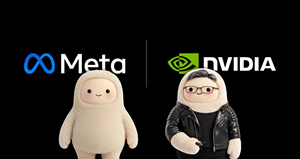
NVIDIA and Meta Muse collaboration is set to expand as the two technology companies deepen their work on the Muse family of artificial intelligence models. Announced on October 27, 2026, the partnership aims to improve training and inference performance, reflecting growing demand for useful AI agents and more capable AI-powered applications.
The expanded collaboration will bring together Meta’s Muse models and agents with NVIDIA’s computing infrastructure. Both companies intend to optimize performance across workflows, improve efficiency and strengthen the overall economics of deploying AI systems at scale.
The announcement reinforces the long-term relationship between NVIDIA and Meta as businesses increasingly invest in AI infrastructure and intelligent software capable of performing tasks on behalf of users.
Muse Models and AI Agents Drive the Expanded Partnership
Meta’s Muse models and agents leverage NVIDIA infrastructure and have delivered frontier-level benchmark performance, according to the companies. Since launch, the models have also experienced surging consumer downloads.
Under the expanded partnership, engineering teams will work on optimizations across workflows to maximize performance and improve total cost of ownership (TCO). The focus is on making AI model training and inference more efficient while supporting the development of increasingly capable AI agents.
AI agents represent an emerging shift in how people interact with software. Rather than simply responding to individual instructions, these systems are designed to understand goals, reason through tasks, use digital tools and complete work on behalf of users.
For enterprises, this development could influence how software applications, business workflows and digital services are designed and operated. However, the announcement does not specify a deployment timeline or quantify the expected performance improvements from the expanded Muse collaboration.
NVIDIA OpenShell and Sentry Bring Security Into Focus
Beyond model performance, NVIDIA and Meta are considering additional technological collaboration around agent security and monitoring.
One area under consideration is the NVIDIA OpenShell Reference Architecture, including NVIDIA OpenShell for safe deployment and NVIDIA Sentry for monitoring agent behavior.
As AI agents gain the ability to interact with tools and carry out multi-step tasks, organizations face new requirements around deployment controls, operational visibility and security. Monitoring agent behavior and establishing safer deployment environments are therefore important parts of building AI systems that can operate reliably.
The companies have indicated that they will explore further collaboration in these areas. These possibilities are under consideration and should not be interpreted as a confirmed product rollout or completed implementation.
Meta Expands Its NVIDIA Infrastructure Deployment
The partnership also extends to the computing and networking infrastructure supporting Meta’s AI ambitions.
Meta intends to expand its deployment of NVIDIA infrastructure, including NVIDIA Vera Rubin and Vera CPUs, to support next-generation AI agents and maximize performance per watt.
The company also plans to deploy NVIDIA Spectrum-X Ethernet networking and BlueField-4 to improve network efficiency and throughput.
These infrastructure investments reflect the growing computing requirements associated with training and running advanced AI models. As AI workloads expand, performance is no longer determined by processors alone. Networking, data movement, software optimization and energy efficiency all contribute to the ability to operate AI systems at scale.
For Meta, expanding this infrastructure is intended to support its broader AI roadmap and the development of personal AI agents for a global user base.
NVIDIA Announces a $4 Billion Investment in Meta
Alongside the expanded technology partnership, NVIDIA announced that it will invest $4 billion in Meta’s equity offering.
The investment adds a financial dimension to the companies’ already significant strategic relationship. It comes as both organizations continue to position AI infrastructure and advanced models as important areas of long-term development.
The announcement did not provide further details about the investment’s structure, completion timeline or applicable closing conditions. NVIDIA also noted that the proposed investment is subject to relevant conditions, as outlined in its forward-looking statements.
Jensen Huang and Mark Zuckerberg Highlight the Future of AI Agents
Jensen Huang, founder and CEO of NVIDIA, described AI agents as a new computing paradigm in which software can understand goals, reason, use tools and complete tasks on behalf of people.Huang said the expanded partnership would focus on optimizing computing infrastructure end to end to support capable, efficient and secure AI agents. He also emphasized the potential for Muse to help billions of people achieve more.
Mark Zuckerberg, founder and CEO of Meta, described Muse as a way to bring personal superintelligence to everyone. He said Meta is looking forward to continuing its work with NVIDIA to deliver personal agents and frontier models to billions of people.The comments underline the shared ambition behind the collaboration: combining advanced AI models with the computing infrastructure required to make intelligent agents more useful and accessible.
What the Expanded Partnership Means for the AI Industry
The NVIDIA and Meta announcement highlights how competition in artificial intelligence is increasingly extending beyond the development of individual models.
The next phase of AI advancement will depend on the integration of models, computing platforms, networking, software and security. Companies developing AI agents will need infrastructure capable of supporting demanding training and inference workloads while maintaining operational efficiency.
For enterprises, the progress of agent-based systems could create opportunities to automate complex workflows, improve access to information and change how employees interact with software. At the same time, security, monitoring, reliability and total cost of ownership will remain important considerations as organizations evaluate adoption.
By expanding their collaboration on Muse, exploring agent-security technologies and increasing infrastructure deployment, NVIDIA and Meta are strengthening a partnership focused on the next generation of AI computing.
The announcement signals a broader industry direction: the future of AI will not be shaped by models alone, but by the infrastructure and systems that enable intelligent agents to work at scale.


 Share your Details for subscribe