


As Industry 4.0 accelerates across global markets, the role of communication in driving adoption has become as critical as the technology itself. A new generation of robotics and automation influencers is bridging the gap between innovation and implementation. These individuals are not just content creators—they are educators, storytellers, and ecosystem builders shaping how industries understand and adopt advanced technologies like robotics, AI, and Physical AI.
The Rise of Industry Communicators
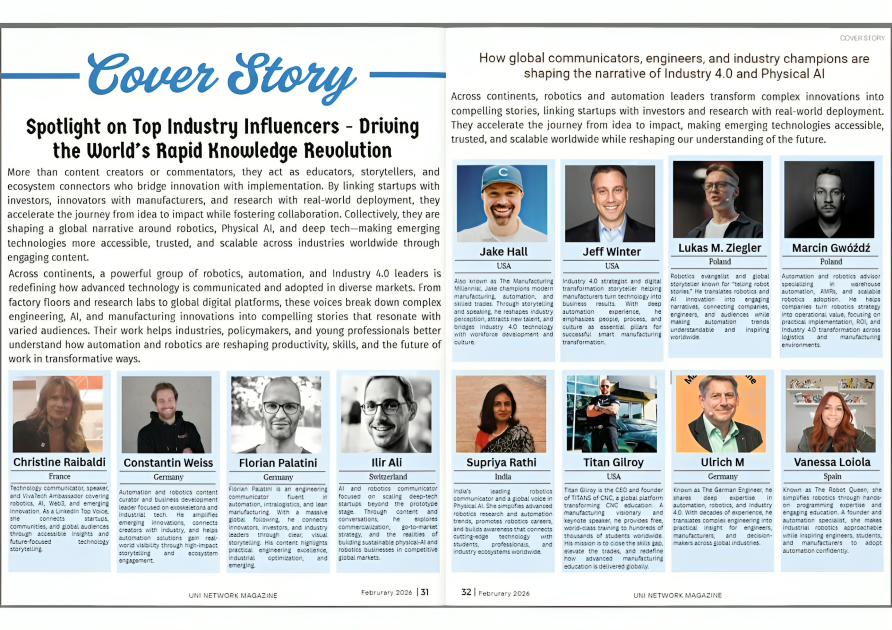
Across continents, influential voices such as Ilir Ali (Switzerland), Constantin Weiss (Germany), Florian Palatini (Germany), and Christine Raibaldi (France) are redefining how deep-tech innovations are presented. By translating complex engineering concepts into accessible insights, they enable industries, policymakers, and young professionals to better grasp the implications of automation.
Their work spans topics such as commercialization strategies, exoskeletons, intralogistics, and emerging technologies like Web3 and AI – helping audiences move beyond theory into real-world understanding.
Operational Impact: Bridging Innovation with Implementation
These global communicators play a pivotal role in connecting startups, investors, and manufacturers. Leaders like Vanessa Loiola (Spain), widely known as “The Robot Queen,” simplify robotics through hands-on programming and education, making automation more approachable for engineers and students alike.
Similarly, Titan Gilroy (USA), founder of TITANS of CNC, is transforming manufacturing education by providing free, high-quality CNC training globally—addressing the skills gap in advanced manufacturing.
Voices such as Ulrich M (Germany) and Supriya Rathi (India) further amplify practical knowledge by converting technical complexity into actionable insights, ensuring that innovation is not confined to labs but reaches factory floors.
Economic Impact: Accelerating Adoption and Workforce Development
By promoting awareness and understanding, these influencers significantly contribute to accelerating technology adoption. Jake Hall (USA), known as “The Manufacturing Millennial,” is reshaping perceptions around manufacturing careers, attracting new talent and bridging workforce gaps.
At the same time, experts like Marcin Gwóźdź (Poland) focus on practical implementation—helping organizations translate robotics strategies into measurable ROI, particularly in warehouse automation and logistics.
Their combined efforts support economic growth by enabling industries to deploy automation efficiently while building a skilled workforce ready for the future.
Strategic Significance: Shaping the Future of Physical AI
Beyond education and awareness, these leaders are shaping the global narrative of Physical AI and smart manufacturing. Influencers such as Lukas M. Ziegler (Poland) and Jeff Winter (USA) emphasize storytelling as a strategic tool – connecting technological innovation with business value and human impact.
Collectively, they are creating a unified global ecosystem where ideas, talent, and technology flow seamlessly across borders. Their influence ensures that robotics and AI are not just advanced concepts but scalable, trusted solutions driving real-world transformation.
Conclusion
The rise of robotics and automation communicators marks a critical shift in the Industry 4.0 landscape. By making complex technologies understandable, relatable, and actionable, they accelerate the journey from innovation to impact. As global industries continue to evolve, these voices will remain essential in shaping a future where technology is not only advanced—but also accessible, inclusive, and widely adopted.

 Share your Details for subscribe