


Every industrial revolution has been defined by the people and technologies that reshaped production. From the mills of Lancashire to the assembly lines of Detroit and the cleanrooms of Silicon Valley, each era marked a shift in how the world builds. Today, a new transformation is underway—the rise of industrial humanoid robotics.
Powered by advances from companies like NVIDIA and driven by a new generation of robotics innovators, intelligent machines are no longer confined to research labs. They are actively operating on factory floors, construction sites, and logistics hubs, signaling the arrival of a new industrial age.
Context: From Automation to Autonomous Intelligence
The last three years have marked a quiet but profound shift in industrial robotics. There was no single defining moment—no breakthrough announcement or landmark launch. Instead, transformation occurred gradually across global manufacturing hubs, from the United States to India.
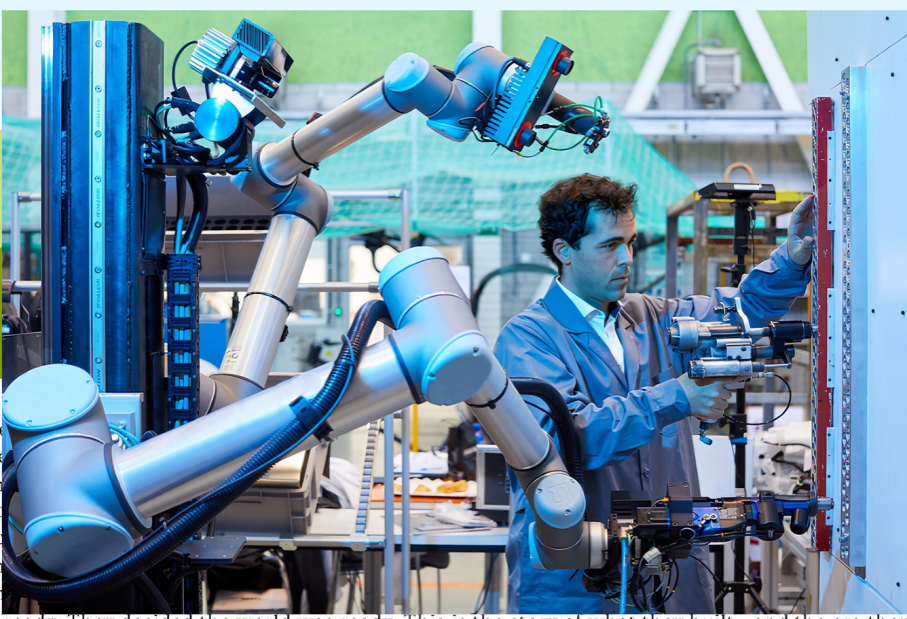
Organizations such as the International Federation of Robotics report a surge in robot adoption, with millions of industrial robots now deployed worldwide. What was once limited to repetitive automation has evolved into intelligent systems capable of real-time decision-making and adaptive learning.
This transition reflects a deeper change: factories are no longer static production lines but dynamic ecosystems powered by data, AI, and machine intelligence.
Operational Shift: Robots Enter the Workforce
Industrial robots have officially moved beyond pilot programs. Today, they are integrated into daily operations—handling tasks ranging from material movement to complex assembly.
Companies like Boston Dynamics and Agility Robotics are deploying robots that can navigate unpredictable environments such as warehouses and construction sites. Meanwhile, emerging players like Figure AI are building humanoid systems designed to work alongside human labor.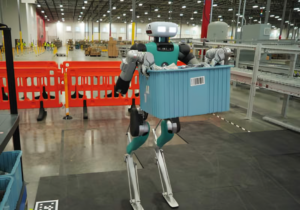
This operational shift is also driven by cost efficiency. Hardware that once required massive capital investment is now becoming increasingly accessible, enabling wider adoption across industries.
Economic Impact: Automation Meets Labor Shortage
One of the most significant drivers behind this transformation is the global labor shortage. In the United States alone, hundreds of thousands of manufacturing jobs remain unfilled, accelerating the need for automation.
According to insights from McKinsey & Company, automation is no longer a long-term strategy—it is an immediate business necessity. The combination of rising labor costs, workforce gaps, and increasing production demands has pushed companies toward robotic solutions.
Market projections further reinforce this trend. The global robotics industry is expected to grow significantly, reaching nearly $90 billion by 2030, reflecting rapid adoption and technological maturity.
 Strategic Significance: Building the Industrial Ecosystem
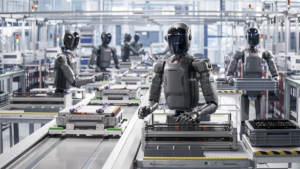
The rise of industrial humanoids is not just about robots—it is about building an entire ecosystem. This includes AI systems, hardware infrastructure, deployment strategies, and service networks.
As Jensen Huang отметил, humanoid robotics could become “one of the largest industries ever.” This vision highlights the scale of transformation underway.
Leading automation companies such as ABB Robotics and KUKA are already integrating AI-driven solutions into smart factories, creating environments where machines and humans collaborate seamlessly.
This shift marks the emergence of “industrial architects”—organizations that design factories as intelligent, adaptive ecosystems rather than linear production lines.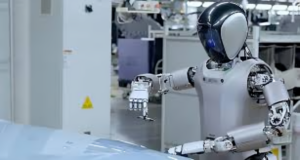
Conclusion
The industrial humanoid era has not arrived with fanfare—it has arrived with deployment. Robots are no longer experimental technologies; they are operational assets, working alongside humans to redefine productivity and efficiency.
What makes this moment significant is not just the technology itself, but the scale at which it is being adopted. Across factories, warehouses, and construction sites, a new workforce is emerging—one that blends human ingenuity with machine intelligence.


 Share your Details for subscribe