




As industrial companies face persistent labor shortages, rising productivity demands and increasingly complex operating environments, Caterpillar Inc. is expanding its use of artificial intelligence and robotics through a new collaboration with FieldAI.
The partnership focuses on advancing physical AI, autonomous robotics and digital twin technologies across Caterpillar’s jobsites and manufacturing facilities. By combining real-time operational data with AI-powered machines and simulation technologies, the companies aim to help industrial operations improve safety, productivity and decision-making.
Unlike conventional software AI, physical AI enables intelligent systems to understand and respond to real-world environments. For industries such as construction, mining and manufacturing, this capability can provide machines and robots with greater awareness of changing conditions and enable them to operate with less human intervention.
Bringing Physical AI to Heavy Industry
Caterpillar’s collaboration with FieldAI combines the company’s extensive industrial expertise, engineering capabilities and operational data with FieldAI’s robot-agnostic foundation models.
FieldAI develops AI systems designed to operate in unstructured and dynamic environments, where traditional automation can struggle because conditions are constantly changing. Its technology is intended to function as a universal “brain” across different robotic platforms and tasks.
For Caterpillar, this creates opportunities to deploy intelligent systems beyond traditional fixed automation, particularly across complex manufacturing environments and construction and mining jobsites.
“These technologies give our teams greater visibility into how our facilities operate and help us identify opportunities to improve safety, optimize flow and make more informed decisions,” said John Tuntland, Caterpillar’s senior vice president of Integrated Components Division.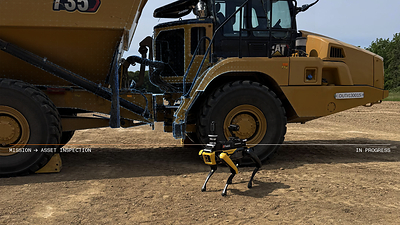
Digital Twins Create a New Layer of Operational Visibility
One of the key technologies supporting the collaboration is digital twin technology.
Digital twins can create detailed virtual representations of physical facilities, equipment and operational processes. By connecting these virtual environments with real-world operational data, industrial teams can simulate processes, identify potential risks and evaluate improvements before implementing changes on the factory floor or jobsite.
For Caterpillar, digital twins are expected to provide enhanced visibility into facility operations while supporting applications such as workflow optimization, infrastructure monitoring and operational planning.
The technology can also work alongside AI and robotics, creating a feedback loop in which real-world observations inform digital models while simulations help teams make better operational decisions.
Four Early Applications
The collaboration will initially focus on several practical industrial applications:
- Autonomous inspections: AI-powered robots can inspect facilities and jobsites to improve safety and operational visibility.
- Digital twins: Real-time operational information can be represented in virtual environments to improve monitoring and optimization.
- Enhanced situational awareness: AI can help identify potential hazards and operational risks earlier.
- Operational optimization: Simulation, automation and AI-driven insights can help improve industrial workflows and resource utilization.
These applications reflect a broader shift in industrial automation from isolated robotic tasks toward connected, intelligent systems capable of adapting to changing environments.
NVIDIA Technologies Support the Industrial AI Strategy
The collaboration will also leverage NVIDIA accelerated computing and NVIDIA Omniverse technologies to support AI-powered autonomy and high-fidelity digital twins.
By combining accelerated computing with operational data, Caterpillar and FieldAI aim to improve the ability of industrial teams to visualize complex environments, simulate scenarios and accelerate decision-making.
This technology foundation supports Caterpillar’s broader vision for the jobsite of the future, where intelligent machines, connected workflows and digital insights work together to create safer and more productive operations.
From Automation to Autonomy
The partnership represents an important evolution in industrial automation.
Traditional automation has typically been designed around predictable processes and predefined tasks. Physical AI introduces a more adaptive approach, allowing robots and intelligent machines to interpret their surroundings and respond to changing conditions.
For Caterpillar, this could be particularly valuable in construction, mining and manufacturing environments where unpredictable conditions make conventional automation more difficult to deploy.
“Caterpillar has shaped operations on jobsites and manufacturing facilities for over a century, and these are exactly the environments FieldAI excels in,” said Ali Agha, founder and CEO of FieldAI. “Together, we are shaping the next century of AI-enabled heavy industry.”
Building the Next Generation of Industrial Operations
The Caterpillar–FieldAI collaboration highlights how physical AI, robotics, digital twins and accelerated computing are converging to reshape heavy industry.
As manufacturers and industrial operators look for ways to address workforce challenges while increasing safety and productivity, intelligent machines could become increasingly integrated into everyday operations.
For Caterpillar, the objective is not simply to automate individual tasks, but to create industrial environments that can observe, understand, simulate and respond more intelligently.
The result could be a new generation of jobsites and factories where humans and AI-powered machines work together, supported by real-time data and increasingly autonomous systems.


 Share your Details for subscribe