



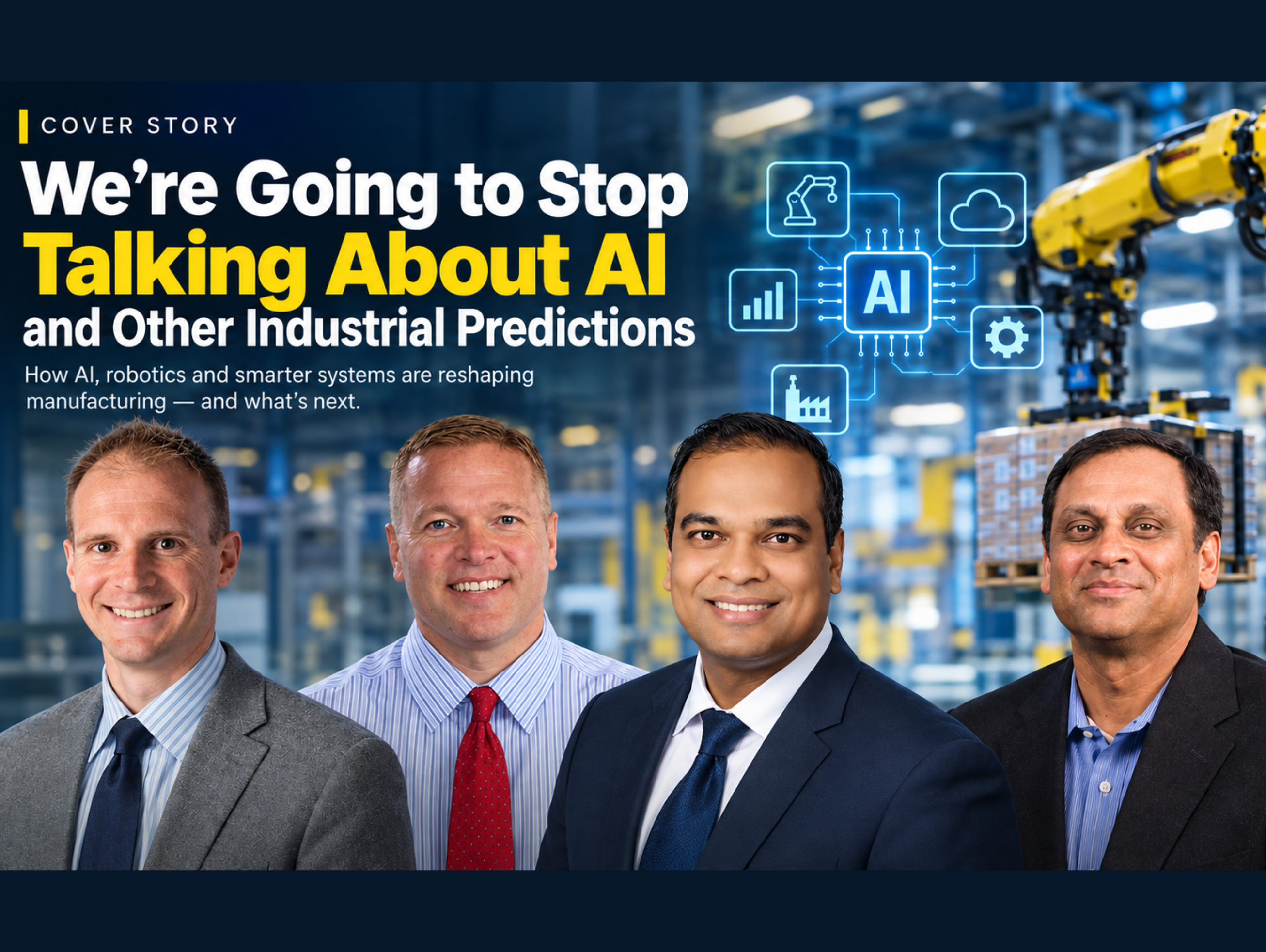
Artificial intelligence is rapidly becoming embedded in industrial operations, moving beyond experimentation and into robotics, factory systems, worker support and production processes. At IMTS in Chicago, executives from FANUC America, Honeywell, Generac and Briggs & Stratton discussed how AI is already influencing manufacturing and what the next phase of adoption could look like.
The discussion, moderated by Praveen Rao, Global Director of Manufacturing at Google Cloud, highlighted a common theme: AI is increasingly becoming part of the infrastructure behind industrial operations rather than a standalone technology.
AI Could Eventually Become Invisible in Manufacturing
Mehul Patel, Chief Technology Officer at Honeywell Technologies, suggested that the industry may eventually stop talking about AI altogether because it will become integrated into everyday manufacturing processes.
Patel described a future in which industrial systems do more than predict what might happen. AI-enabled systems could identify what is happening, explain why it is happening and recommend the actions required in response.
While humans will remain involved in certain industries and applications, Patel said stronger safeguards could allow some processes to operate with less direct human intervention.
This shift would represent a transition from AI as a visible technology initiative to AI as an embedded layer within industrial decision-making and automation.
FANUC Sees AI Expanding the Role of Industrial Robots
Mike Cicco, President and CEO of FANUC America, said the industry is still at an early stage in understanding how AI agents can influence physical robots and machines.
FANUC has experienced significant growth in robot demand as interest in AI and automation has increased. The company produced 500,000 robots between entering the U.S. market in 1982 and 2017. That number doubled to 1 million by 2023, according to Cicco.
FANUC has also expanded its work with Google Cloud, integrating the Gemini Enterprise platform and Intrinsic robotics software into its robotics ecosystem.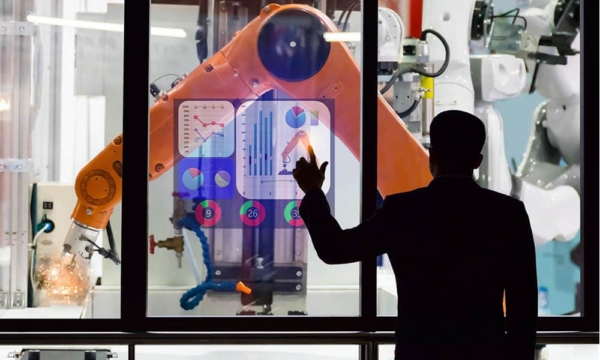
The combination of cloud computing, AI models and industrial robots could allow machines to access significantly greater computing and learning resources.
One example discussed at IMTS involved workers communicating instructions in a simple, natural format. Rather than requiring specialized programming, an operator could identify the parts or task required, with the information then processed through cloud-based AI before being translated into instructions for robotic systems.
Multiple robots could potentially work with the same AI infrastructure and coordinate their activities.
“Now all the things that used to be hard coded into the robot are now completely flexible.”
This points toward a manufacturing environment where programming-intensive automation could increasingly give way to more adaptable, AI-driven robotic systems.
No-Code and Low-Code Tools Could Expand Access to Automation
The increasing accessibility of AI could also change who is able to interact with industrial automation.
Brad Witter, Senior Vice President at Generac, said manufacturing environments could see greater adoption of no-code and low-code technologies. Instead of requiring specialized programming expertise, workers could use simpler interfaces, including “point and click” systems, to establish predictable machine behavior.
Such tools could make automation easier to deploy and modify across manufacturing environments.
The change is particularly significant as manufacturers seek to connect more workers with advanced automation without requiring every employee to become a robotics or software specialist.
AI Could Shift Workers From Data Analysis to Decision-Making
AI’s impact may also extend beyond machines and into the daily responsibilities of manufacturing and supply chain employees.
Erik Syrjanen, Senior Vice President of Supply Chain at Briggs & Stratton, highlighted the amount of time employees currently spend analyzing data within enterprise systems.
As AI becomes increasingly capable of connecting with systems such as Oracle and SAP, it could automate portions of data analysis and recommendation processes.
The potential result is a shift in the role of employees—from spending significant amounts of time interpreting data toward determining what actions should be taken based on the information.
Rather than eliminating the human role, this model emphasizes worker augmentation, with AI handling more of the analytical workload while employees focus on decisions, strategy and execution.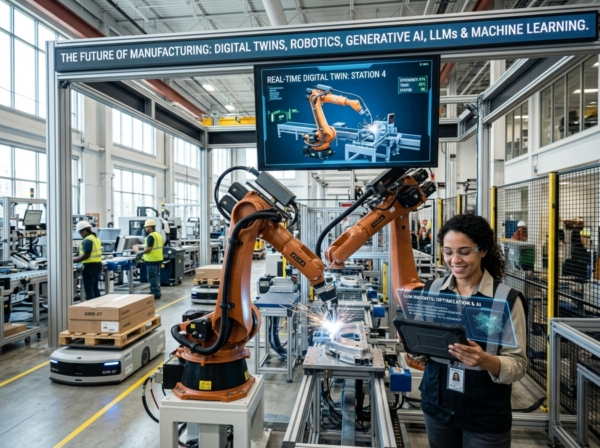
AI and Robotics Will Need Strong Safety Layers
The growing capabilities of industrial AI also raise questions about safety and security, particularly when software systems become connected to physical machines.
During the IMTS discussion, executives emphasized the importance of protective mechanisms between AI-generated instructions and physical machine actions.
Cicco explained that FANUC’s systems include protection layers designed to prevent robots from carrying out movements that could potentially harm people or the machines themselves.
Patel added that physical actions are ultimately managed through control systems, creating an additional layer between AI reasoning and machine behavior.
For industrial environments, this distinction is critical. AI may determine what should happen, but control systems and safety mechanisms can govern whether and how a physical action actually occurs.
“AI plus the control systems is where the breakthroughs are going to happen.”
From AI Experimentation to Industrial Infrastructure
The discussions at IMTS point toward an industrial landscape where AI increasingly operates behind the scenes.
Robotics, cloud platforms, enterprise software, computer vision, factory automation and worker interfaces are becoming more interconnected. As these systems mature, AI may become less visible to workers while becoming more deeply embedded in how factories operate.
The next stage of industrial AI is therefore not simply about adding intelligence to individual machines. It is about connecting intelligence across entire production environments—helping robots adapt, enabling workers to interact with automation more naturally, improving access to operational information and supporting decisions across manufacturing and supply chain functions.
For manufacturers, the evolution will also depend on maintaining the right balance between automation, human oversight and safety.
As Patel’s prediction suggests, the future may arrive when manufacturers no longer need to explicitly discuss whether they are using AI. Instead, AI could simply become part of how industrial work gets done.
Key Takeaways
- AI is moving deeper into manufacturing operations, with applications spanning robotics, cloud platforms, enterprise systems and worker support.
- Industrial robots are becoming more adaptable, with AI and cloud technologies reducing dependence on traditional hard-coded programming.
- No-code and low-code automation could allow more factory workers to interact directly with advanced technologies.
- AI can augment workers by reducing time spent on repetitive data analysis and allowing employees to focus more on decisions and strategy.
- Safety and control systems remain critical as AI becomes increasingly connected to physical machines.
- The long-term direction is toward embedded AI, where artificial intelligence becomes an underlying part of industrial operations rather than a separate technology layer.
The Road Ahead
The IMTS conversation demonstrates how quickly the relationship between artificial intelligence and physical industry is evolving. From robotic arms and cloud-based intelligence to worker augmentation and automated decision support, AI is increasingly moving from the digital world into the physical factory.


 Share your Details for subscribe