



The future of computing may not depend on quantum processors alone. Instead, the next major breakthrough could emerge from combining quantum computers with the extraordinary processing capabilities of today’s most advanced supercomputers.
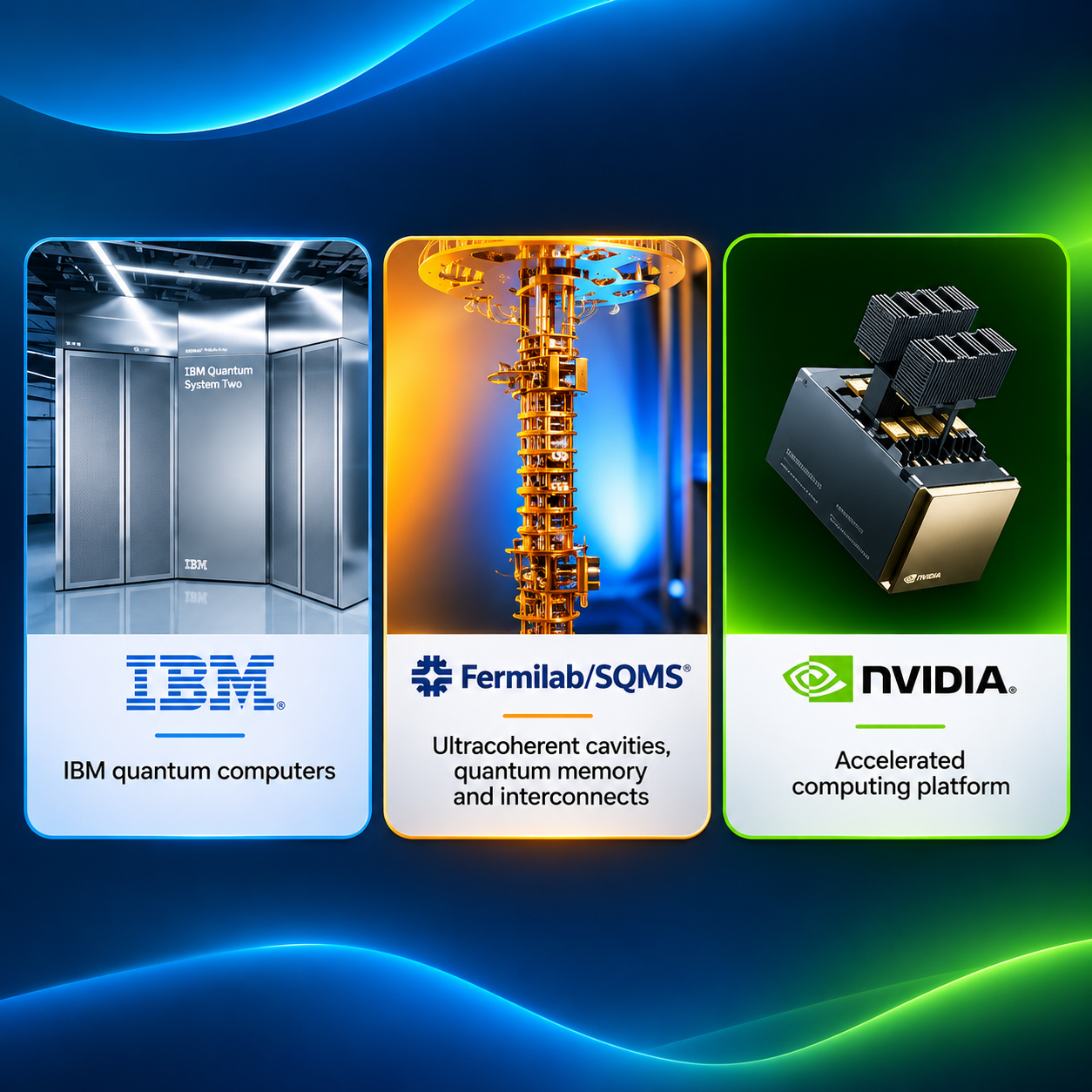
That is the vision behind a new collaboration involving IBM, NVIDIA, and the U.S. Department of Energy’s Fermi National Accelerator Laboratory (Fermilab). Announced on November 16, 2026, the initiative aims to accelerate the development of next-generation modular quantum computers by bringing together quantum hardware, accelerated computing, and scientific research.
The collaboration represents an important step toward making quantum computing more practical for complex scientific applications, particularly in areas where conventional computing systems face significant computational challenges.
Bringing Quantum and Classical Computing Together
One of the biggest challenges in advancing quantum computing is developing systems that can operate reliably at larger scales. Quantum processors work differently from traditional computers. While classical computers process information using bits represented as zeros and ones, quantum computers use quantum bits, or qubits, which can represent more complex states through quantum mechanical principles.
However, quantum processors are sensitive to errors and environmental disturbances. Building reliable, scalable systems requires advances in hardware, error correction, software, and system integration. To address these challenges, IBM, NVIDIA, and Fermilab plan to develop a modular quantum computing co-design platform.
The proposed platform will bring together NVIDIA DGX B200 accelerated computing systems and IBM quantum computers, including systems powered by IBM Quantum Nighthawk. Each organization will contribute different capabilities:
IBM: Advanced superconducting quantum processors, quantum software, networking expertise, and application development.
NVIDIA: Accelerated computing, AI infrastructure, simulation capabilities, and software for quantum error-correction research.
Fermilab: Scientific research expertise, superconducting quantum hardware development, and applications in high-energy and nuclear physics.
By combining these capabilities, researchers aim to explore how multiple quantum processors can work together while classical computing systems support increasingly complex workloads.
Why Quantum Computing Needs AI and Supercomputing
Quantum computing is often described as a technology that could solve problems beyond the practical capabilities of conventional computers. However, its development requires significant support from classical computing infrastructure. This is where NVIDIA’s accelerated computing technology becomes particularly important.
The collaboration will investigate how quantum processors and GPU-powered computing systems can operate together in integrated scientific workflows. One major area of development involves quantum error correction. Quantum systems are vulnerable to errors that can affect the accuracy of calculations. Researchers use specialized algorithms called decoders to interpret measurement results and identify potential errors.
NVIDIA has also announced a new TCBP-JOBS decoding algorithm through its CUDA-Q platform. According to NVIDIA, it can accelerate certain quantum error-correction research workloads by up to 13,000 times compared with existing leading algorithms.
The company reports that this reduces a particular computational research task from approximately 12 weeks to 45 minutes. This is a significant research development, although it should not be interpreted as a 13,000-fold improvement in quantum processor performance itself.
Scientific Research Could Benefit From the Collaboration
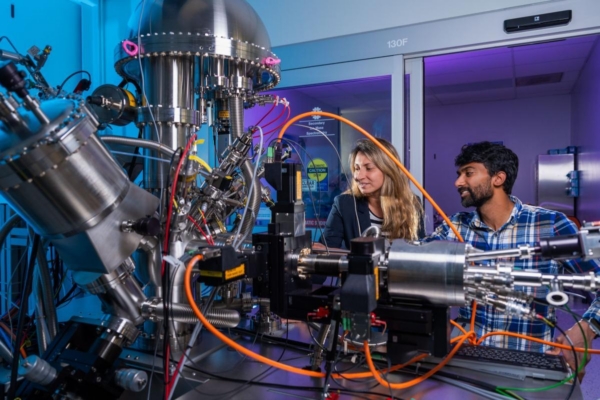
The partnership is particularly focused on computationally demanding scientific applications. Researchers at Fermilab will explore how quantum-classical computing systems could support high-energy and nuclear physics research.
Potential research areas include:
- Particle interactions and high-energy physics.
- Neutrino physics and nuclear simulations.
- Quantum error correction and fault-tolerant computing.
- Complex scientific modelling.
- The development of interconnected quantum processor architectures.
- These applications involve highly complex calculations that can require substantial computing resources.
By combining quantum processing with advanced classical computing, researchers hope to develop new approaches to scientific problems that remain difficult for existing computing systems.
A Major Step Toward Integrating Quantum Computing Into Supercomputers
Another important development involves integrating quantum processors into existing high-performance computing workflows. IBM and NVIDIA are working with the open-source community on the Quantum Resource Management Interface (QRMI), which connects quantum computing resources with Slurm, a widely used workload manager for supercomputing environments.
Traditionally, research institutions have needed specialized methods to manage quantum processors alongside CPUs and GPUs. The new integration aims to simplify this process by allowing quantum resources to be scheduled and managed within familiar supercomputing workflows.
This could make hybrid quantum-classical computing more accessible to research institutions and scientific computing facilities. It also represents an important development in building the infrastructure required for future quantum computing systems.
What This Means for the U.S. Technology Industry
The United States continues to play an important role in developing advanced computing technologies, particularly through collaborations between technology companies, national laboratories, and research institutions.
The IBM, NVIDIA, and Fermilab initiative highlights how different areas of technological expertise can come together to address some of computing’s most difficult challenges. For the technology industry, the potential impact extends across several sectors:
- Artificial Intelligence: Advanced computing infrastructure could support increasingly complex AI and scientific workloads.
- Healthcare and Biotechnology: Quantum computing research may eventually support more sophisticated molecular and chemical simulations.
- Energy and Materials Science: Advanced simulations could help researchers investigate materials and complex physical systems.
- Scientific Research: Hybrid computing architectures could provide new tools for exploring problems in physics and other scientific disciplines.
- However, these applications remain research opportunities rather than established commercial outcomes. Building practical, fault-tolerant quantum computers will require further advances in hardware, error correction, and scalability.
UNI Network Group Perspective: The Future Will Be Hybrid
The collaboration between IBM, NVIDIA, and Fermilab highlights an important direction in the evolution of computing. Rather than viewing quantum computing, artificial intelligence, and supercomputing as separate technologies, the industry is increasingly exploring how they can work together.
The combination of quantum processors and accelerated classical computing could create new opportunities for scientific discovery, industrial research, and advanced technological development. For the United States, collaborations of this kind also strengthen the connection between private-sector innovation and national research infrastructure.
The journey toward practical quantum computing is still evolving, but the foundations of the next generation of computing are being developed today. The future of computing may not belong to quantum or classical systems alone. It may belong to the intelligent combination of both.


 Share your Details for subscribe