




The race to develop commercially useful quantum computers is gaining momentum in the United States, with the federal government making another significant investment in next-generation computing technology.
On November 13, 2026, the U.S. Department of Commerce announced the finalization of a research and development award worth up to $100 million for Atom Computing, a company developing scalable neutral-atom quantum computers. The award, finalized under the CHIPS and Science Act, is designed to accelerate research into the hardware and systems integration needed to develop commercially useful quantum computing systems.
The investment highlights the growing importance of quantum technology in America’s long-term strategy for advanced computing, semiconductor innovation, and technological competitiveness. More importantly, it signals a shift in focus from developing experimental quantum systems toward building the engineering infrastructure required to make these technologies practical at scale.

What Is Atom Computing Developing?
Based in Boulder, Colorado, Atom Computing is developing quantum computers using an approach known as neutral-atom quantum computing. Unlike conventional computers, which process information using classical bits, quantum computers use quantum bits, or qubits, to perform specialized computations using the principles of quantum mechanics.
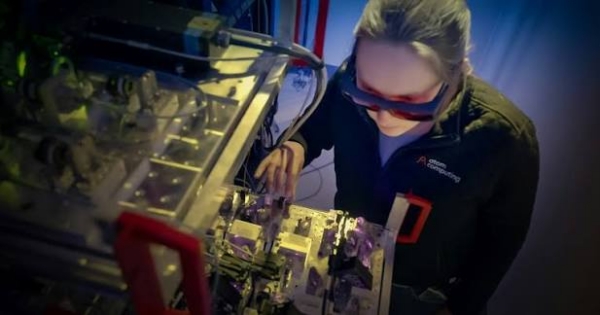
Atom Computing’s technology uses individual neutral atoms held in precisely controlled optical traps created using lasers. These atoms serve as nuclear-spin qubits and can be manipulated through carefully controlled laser-based systems. One of the potential advantages of this architecture is its ability to arrange large numbers of atoms into scalable arrays.
However, building a commercially useful quantum computer involves more than increasing the number of qubits. Researchers must also improve control, connectivity, reliability, error correction, and overall system performance. This is precisely where the new federal investment becomes important.
Where Will the $100 Million Investment Go?
According to the Department of Commerce, the award will support several strategic research and development activities aimed at advancing neutral-atom quantum computing.
The funding will focus on three important areas.
1. Development of Critical Technologies
Atom Computing plans to accelerate in-house development of essential components and technologies. This will help improve system performance, reliability, and integration while reducing dependence on external components for critical engineering capabilities.
2. Expansion of Engineering and Testing Infrastructure
The company will expand its parallel engineering and testbed infrastructure. This approach will allow multiple technologies and system improvements to be evaluated simultaneously, helping accelerate development and validation.
3. Collaboration With Supply Chain Partners
The award will also support research and development partnerships with key supply chain organizations. These collaborations are intended to improve manufacturing capabilities and support the development of larger quantum computing systems.
An important technical objective identified by the Department of Commerce is developing hardware and systems integration capable of manipulating, controlling, and addressing tens of thousands of qubits, while validating their performance. This is a development target, not a claim that such a system has already been completed.
Why Neutral-Atom Quantum Computing Matters
Quantum computing is attracting increasing attention because it could eventually help address specialized computational problems that are difficult for conventional computing systems. Neutral-atom technology represents one of several approaches being explored by researchers and technology companies.
Its architecture relies on individually controlled atoms rather than traditional electronic circuits to represent quantum information. This creates opportunities for developing large-scale qubit arrays and exploring new approaches to quantum information processing.
However, significant engineering challenges remain, including maintaining quantum coherence, controlling individual atoms accurately, improving connectivity, and implementing effective error correction. Addressing these challenges will be essential before large-scale quantum computers can deliver reliable commercial value.
Atom Computing’s research program is therefore focused not simply on increasing qubit numbers, but also on developing the hardware and integration capabilities needed for practical quantum systems.
America’s Growing Investment in Quantum Technology
The Atom Computing award is part of a broader federal initiative to strengthen the U.S. quantum computing ecosystem. In May 2026, the Department of Commerce announced nine letters of intent representing approximately $2.013 billion in proposed federal incentives for quantum foundries and quantum computing companies.
The initiative included companies working across different quantum computing architectures, including neutral-atom, superconducting, trapped-ion, silicon-spin, and photonic technologies. This broader investment strategy reflects the fact that there is no single established architecture that has solved every challenge associated with building scalable, fault-tolerant quantum computers.
By supporting different technological approaches, the United States is investing in a wider research and manufacturing ecosystem. The final Atom Computing award represents one concrete step in moving that broader initiative from proposed funding toward signed research and development agreements.
What Could This Mean for the U.S. Technology Industry?
The development of commercially useful quantum computers could have implications across multiple industries.
- Healthcare and Biotechnology: Quantum computing research may eventually support advanced molecular modelling and help investigate complex chemical interactions.
- Advanced Materials: Researchers could explore new approaches to simulating material properties and understanding complex physical systems.
- Financial Services: Quantum algorithms may offer new approaches to certain optimization and modelling problems, although practical advantages remain to be demonstrated.
- Energy and Manufacturing: Advanced simulations could eventually support research into energy systems, materials development, and industrial processes.
- Artificial Intelligence and High-Performance Computing: Quantum computing could complement classical computing infrastructure in specialized applications, creating opportunities for hybrid computing architectures.
These are potential long-term applications, not immediate commercial outcomes of the funding award.
The Growing Demand for Quantum Engineering Talent
As investment in quantum technology increases, the industry will also require professionals with specialized technical expertise. The development of large-scale quantum systems involves several interconnected disciplines, including physics, electrical engineering, photonics, semiconductor manufacturing, computer science, and advanced materials research.
This creates opportunities for engineers, researchers, software developers, hardware specialists, and scientists working at the intersection of these fields. Universities, research laboratories, and technology companies will play an important role in developing the skilled workforce needed to support this emerging industry.
UNI Network Group Perspective: The Race for Practical Quantum Computing Is Accelerating
The U.S. Department of Commerce’s award of up to $100 million to Atom Computing represents an important development in America’s quantum technology ambitions.
While quantum computing still faces substantial scientific and engineering challenges, investments in hardware development, testing infrastructure, and manufacturing integration are essential to moving the technology forward. The broader significance of this announcement lies in the growing connection between government investment, private-sector innovation, and advanced technology research.
As companies continue exploring different quantum architectures, the next major breakthroughs may come not only from scientific discoveries but also from the engineering systems that make those discoveries commercially useful.For the United States, strengthening domestic quantum capabilities could become an important part of its future technology and manufacturing leadership.
The next computing revolution will not be built on software alone. It will require breakthroughs in hardware, engineering, and the science of controlling matter at its most fundamental level.


 Share your Details for subscribe