

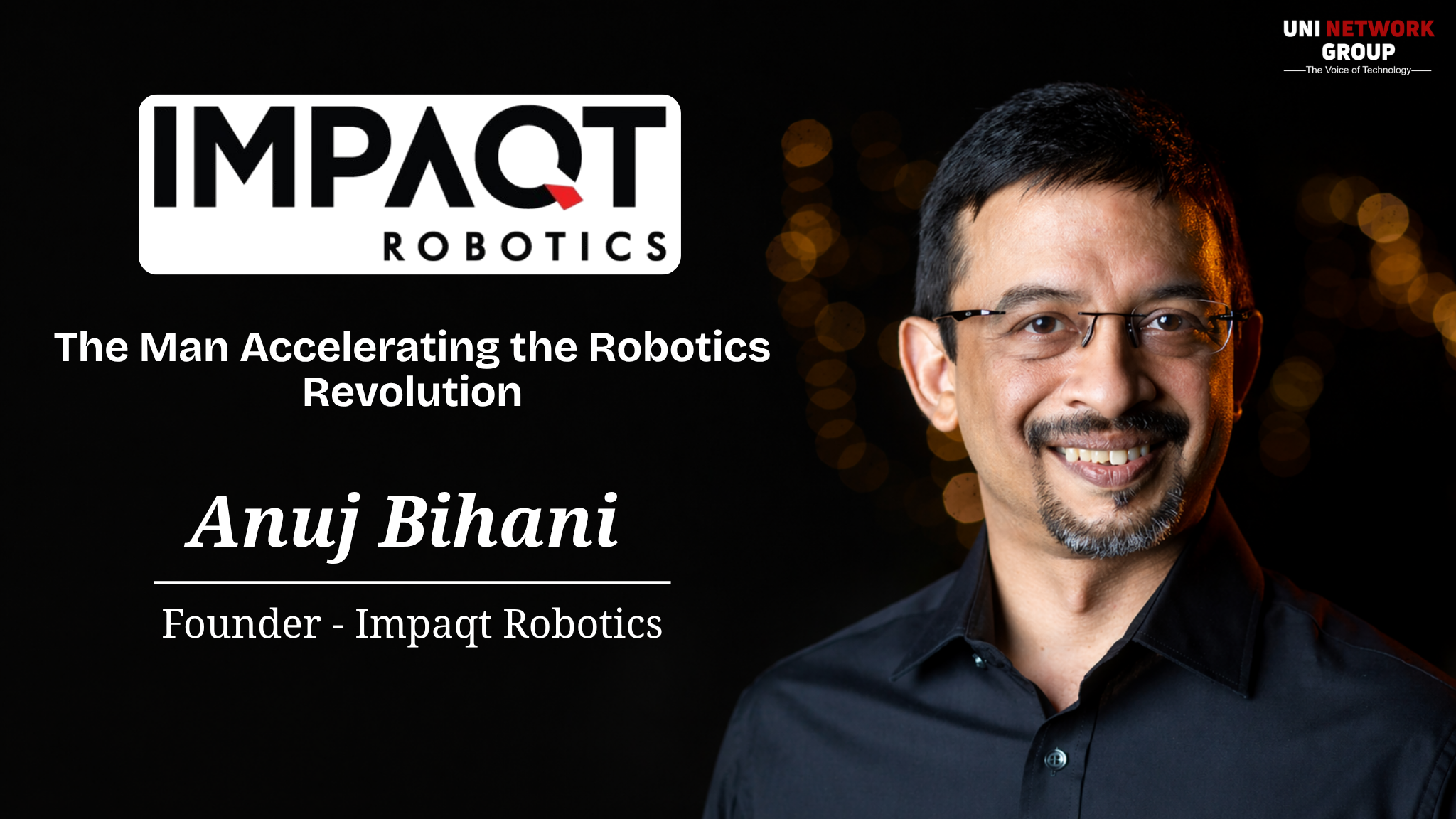
The Man Accelerating the Robotics Revolution
How Anuj Bihani Is Redefining Speed, Scale, and Strategy in Global Manufacturing
February 04, 2026
In an era where manufacturing competitiveness is defined by speed, adaptability, and precision, one leader is quietly transforming how robotics is deployed- not just in India, but across the world.
KEY TAKEAWAYS
- Anuj Bihani emphasizes transforming robotics deployment from slow, complex projects into fast, scalable solutions that align automation with modern manufacturing speed.
- Through alstrut India and Impaqt Robotics, Bihani combines factory-floor insights with product innovation to dramatically reduce robot deployment timelines.
- He believes robotics is no longer optional, urging manufacturers to adopt automation early to achieve resilience, scalability, and global-quality production.
With nearly three decades of experience in automation and robotics, Anuj Bihani, CEO of alstrut India Pvt. Ltd. and Founder of Impaqt Robotics Pvt. Ltd., is driving a fundamental shift in how manufacturers think about automation – from slow, complex projects to fast, scalable business enablers.
This is the story of how real factory-floor challenges gave birth to global innovation – and why robotics is no longer optional for manufacturers who want to lead.
Q1. Mr. Bihani, welcome to UNI Network Group. To begin, could you take us through your professional journey and what drew you to the world of automation and robotics?
Ans. Thank you – it’s a pleasure to be part of UNI Network Group. My journey in automation and robotics spans close to three decades. Over the years, I’ve worked across system integration, industrial automation, and advanced robotics, both in India and internationally, including a professional stint in the United States.
What consistently stood out to me was the gap between technological capability and real-world adoption. Robotics had enormous potential, but deployment on the shop floor was often slow, complex, and intimidating for manufacturers. That realization became the foundation for everything we do today at alstrut and Impaqt Robotics.

Q2. You lead two companies – alstrut India Impaqt Robotics – each with a distinct focus. How do you differentiate their roles while maintaining strategic alignment?
Ans. That distinction is very deliberate.
alstrut India is a robotics systems integration company. We work directly with manufacturers, solving real production challenges – tight deadlines, labor variability, quality pressures, and cost constraints. This gives us deep insight into what actually happens on the factory floor.
Impaqt Robotics, on the other hand, is a product company. It was born from the recurring challenges we encountered at alstrut – especially the slow pace of robot deployment. Impaqt Robotics develops standardized, intelligent solutions that compress deployment timelines dramatically.
alstrut identifies the problem. Impaqt Robotics solves it at scale. Together, they form a continuous innovation cycle.
Q3. Can you share a concrete example that demonstrates the real impact of your solutions?
Ans. Certainly. Take common applications like machine tending or palletizing. Traditionally, even after all components are ready, deployment takes three to five weeks due to design, programming, and integration complexity.
With Impaqt Robotics’ solutions, the same applications can be deployed in two to three days. This fundamentally changes automation economics. Robotics becomes agile, responsive, and aligned with business speed – not a long-term disruption.
Q4. Manufacturing is evolving rapidly. From your perspective, what are the biggest shifts reshaping the industry today?
Ans. Manufacturing today is no longer about volume alone – it’s about speed, flexibility, and predictability. India, in particular, is transitioning from a cost-driven manufacturing hub to a global-quality production base.
Customers now expect:
- Faster turnaround times
- Consistent quality
- Traceability and compliance
- Ability to adapt quickly to market changes
Robotics enables all of this. It’s not about replacing people – it’s about building resilient, future-ready manufacturing systems.
Q5. Indian manufacturers are often price-sensitive, while global markets prioritize quality. How should companies balance these competing pressures?
Ans. The mistake many companies make is focusing only on upfront cost. The real conversation should be around total cost of ownership.
Hidden costs – such as rework, quality failures, absenteeism, delayed deliveries, and customer dissatisfaction – are far more damaging than the initial investment in automation.
When evaluated holistically, robotics consistently proves to be a long-term value generator, not a cost burden.
Q6. Some global manufacturers produce different quality levels for different markets. Is this a strategy you believe in?
Ans. No, I strongly believe that quality should never be market-dependent. While short-term gains may be tempting, inconsistent quality eventually damages brand credibility.
Our philosophy is simple: maintain a single, uncompromising quality standard and continuously improve it. Trust, once lost, is extremely difficult to rebuild.
Q7. Despite clear advantages, robotics adoption still faces resistance. What are the biggest challenges you see today?
Ans. There are three primary barriers:
- Initial investment hesitation, often driven by short-term ROI thinking
- Technology apprehension, especially concerns around maintenance and uptime
- Skill gaps, particularly in robot operation and programming
The good news is that these barriers are diminishing as training improves and early adopters demonstrate success.
Q8. What advice would you give to companies that are just beginning their automation journey?
Ans. Start small – but start now.
Many companies make the mistake of automating the most complex problem first, which delays results and erodes confidence. Instead, begin with a simple, repetitive application that delivers quick wins.
Early success builds confidence, encourages internal buy-in, and makes scaling automation far easier over time.
Q9. For first-time buyers, what kind of investment should companies realistically expect?
Ans. While costs vary by application, a basic robotic automation cell typically starts at around USD 25,000–30,000 and can go up to USD 50,000–60,000 depending on complexity.
That said, the more important question is not cost – but what operational stability and scalability this investment unlocks over the next five to ten years.
Q10. Skill development remains a major concern. How are you addressing this challenge?
Ans. We are the largest partner of Universal Robots in South Asia and operate authorized training centers. These centers provide structured, hands-on training programs for industry professionals.
Our goal is not just to sell robots, but to ensure customers are confident, capable, and self-sufficient in using them.
Q11. Looking five years ahead, what will differentiate world-class manufacturers from average ones?
Ans. The key differentiator will be adaptability through technology. Companies that invest in robotics, modular automation, and digital visibility will scale faster and respond more effectively to change.
Those who delay adoption will continue to struggle with labor dependency and operational unpredictability.
Q12. What is your long-term vision for alstrut India and Impaqt Robotics?
Ans. For alstrut, our vision is to become India’s most trusted collaborative robotics integrator.
For Impaqt Robotics, our ambition is global – to empower integrators worldwide with products that make robot deployment faster, simpler, and more reliable. Ultimately, we want to contribute to a positive transformation of manufacturing ecosystems worldwide.
Q13. Finally, what message would you like to share with manufacturing leaders and decision-makers?
Ans. Robotics is no longer a future concept – it is a present-day necessity. The biggest shift required is not technological, but mental.
Organizations that embrace robotics today will define the manufacturing leaders of tomorrow.
 Editorial Desk







Advertise with Newsletter
 Share your Details for subscribe