



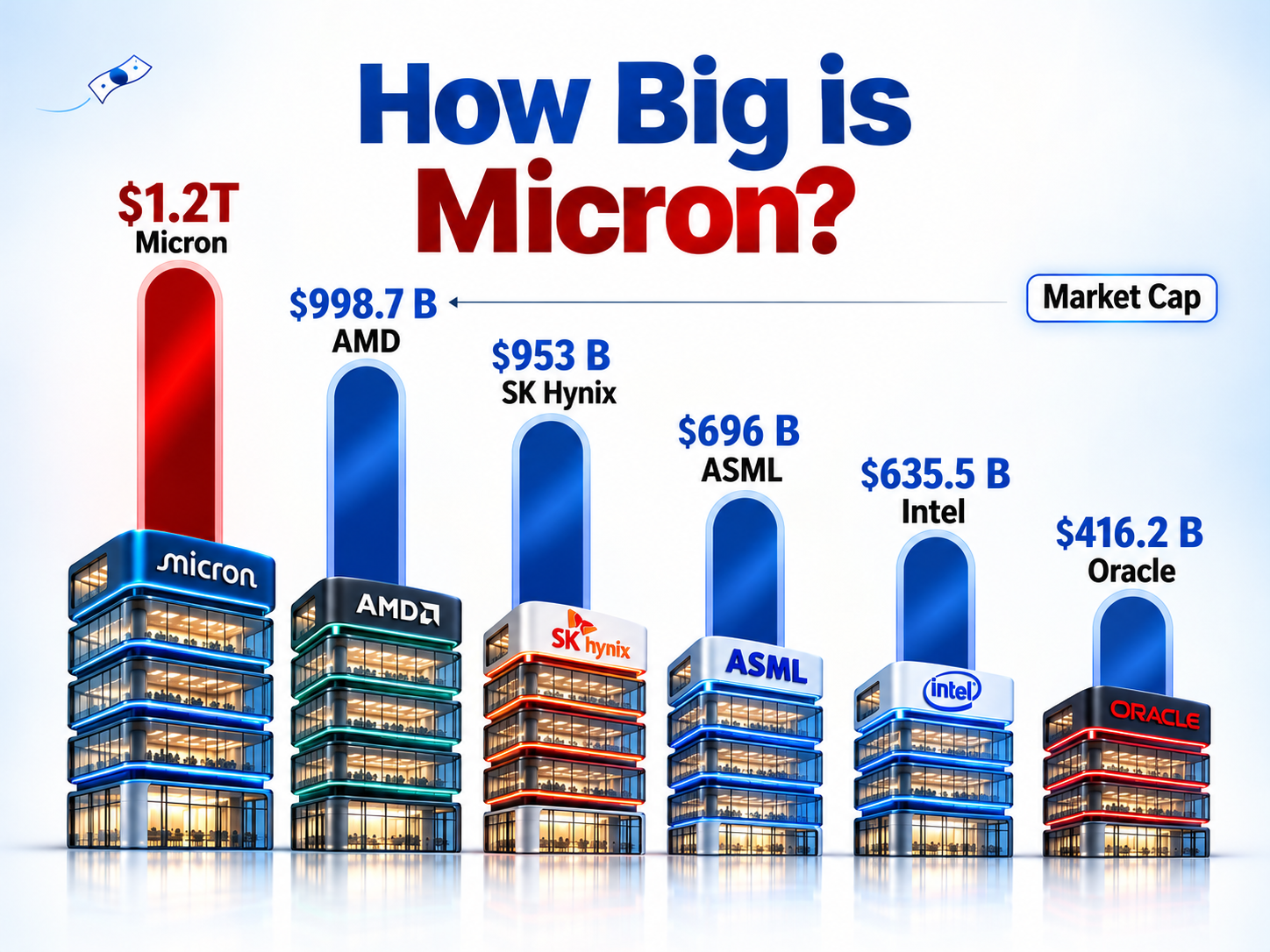
Micron Technology has reached a remarkable milestone in the global technology market, with its market capitalization climbing to approximately $1.2 trillion.
The scale becomes particularly striking when compared with India’s Nifty IT index, which represents a basket of leading Indian information-technology companies. A recent market snapshot puts the combined market capitalization of the Nifty IT constituents at roughly ₹22.85 lakh crore, or about $228 billion at the exchange-rate basis used for the comparison.
On those figures, Micron alone is worth more than five times the combined market capitalization of the Nifty IT companies.
The comparison illustrates how strongly the artificial-intelligence infrastructure boom has reshaped investor expectations around memory and semiconductor companies.
Micron’s Market Cap Has Crossed the $1.2 Trillion Mark
Micron’s market capitalization stood at approximately $1.23 trillion at the October 7, 2026 close, according to market-cap data sourced from Nasdaq Data Link. That made Micron one of the world’s largest publicly traded companies and placed it among the biggest names in the semiconductor industry.
Another market-data source put Micron at approximately $1.20 trillion based on the October 6 close. The small difference reflects normal daily movements in Micron’s share price.
The company has experienced an extraordinary rise in market value over the past year. StockAnalysis data shows Micron’s market capitalization increased by more than 470% over one year, reflecting the sharp re-rating of the memory-chip manufacturer amid surging AI-related demand.
How Micron Compares With Nifty IT
The Nifty IT index consists of major Indian technology companies and is calculated using a free-float market-capitalization methodology.
A recent Nifty IT snapshot showed a total market capitalization of approximately ₹22.85 lakh crore.
Using the roughly $228 billion figure represented in the comparison, Micron’s approximately $1.2 trillion valuation works out to around 5.3 times the market capitalization of the entire Nifty IT index.
| Market measure | Approx. market capitalization |
|---|---|
| Micron Technology | $1.2–$1.23 trillion |
| Nifty IT | ~$228 billion |
| Micron vs. Nifty IT | ~5.3× |
This does not mean Micron generates five times the revenue or profits of all Nifty IT companies combined. Market capitalization reflects what investors collectively value the equity of a company or index constituent basket at—not the amount of revenue generated.
It is therefore best understood as a comparison of market valuation and investor expectations.
AI Has Changed the Economics of Memory
Micron’s extraordinary market-cap expansion is closely connected to the rapid growth of AI infrastructure.
Modern AI systems require enormous amounts of memory and storage. AI accelerators and data-center systems depend on high-performance memory, including high-bandwidth memory (HBM), alongside conventional DRAM and advanced storage technologies.
Micron has increasingly positioned itself as a critical supplier to this infrastructure buildout.
The company’s latest fiscal results provide a clear indication of the scale of the demand cycle.
Micron reported $133.19 billion in fiscal 2026 revenue, compared with $37.38 billion in fiscal 2025. GAAP net income reached $84.97 billion, compared with $8.54 billion the previous year.
For the fourth quarter alone, Micron generated $54.23 billion in revenue, up from $11.32 billion in the same quarter a year earlier. Its quarterly GAAP net income reached $37.70 billion.
Data Centers Are Driving the Transformation
Micron’s latest business-unit figures show just how important AI and data-center demand have become.
In fiscal Q4 2026, its Cloud Memory business generated approximately $16.28 billion in revenue, while the Core Data Center business generated approximately $18.00 billion.
The Core Data Center business reported an extraordinary 85% operating margin during the quarter, compared with 25% a year earlier. Cloud Memory reported a 76% operating margin.
These results demonstrate why investors have increasingly viewed memory as a strategic component of the AI infrastructure economy rather than simply a cyclical semiconductor commodity.
Micron has also been expanding its portfolio of high-value data-center products, including HBM, high-capacity server memory and data-center SSDs. Earlier company guidance highlighted the increasing memory and storage requirements associated with AI data-center deployments.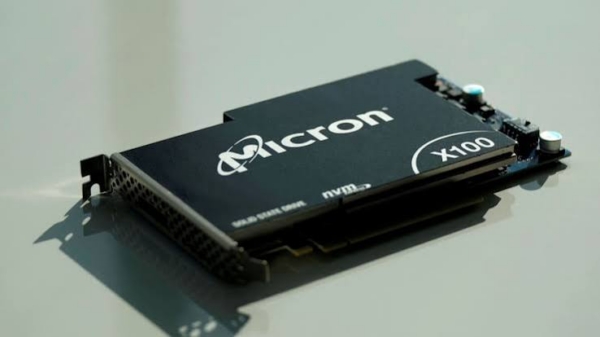
Micron’s Position Within the Semiconductor Race
Micron’s rise has also changed the valuation hierarchy within the semiconductor industry.
Market-cap data from October shows Micron competing at the very top of the industry alongside companies such as SK hynix, AMD, Intel and ASML.
On October 7, Micron was valued at approximately $1.23 trillion, while AMD stood at roughly $1.05 trillion. Intel was around $591 billion in the same market-cap dataset.
Another market-data comparison placed SK hynix above Micron at approximately $1.42 trillion, while AMD stood around $1.03 trillion and Intel around $614 billion.
The exact rankings can change rapidly because semiconductor stocks have experienced substantial price movements during the AI investment cycle.
The broader message, however, is clear: memory has moved much closer to the center of the AI investment story.
Micron’s Record Year Reinforces the Market’s Expectations
Micron’s fiscal 2026 performance represents a dramatic change from the previous year.
Revenue increased from $37.38 billion to $133.19 billion, while net income increased from $8.54 billion to nearly $85 billion.
The company’s full-year capital expenditure also reached approximately $27.37 billion, highlighting the enormous investment required to expand semiconductor manufacturing capacity and meet anticipated demand.
Micron ended fiscal 2026 with approximately $73.48 billion in cash, marketable investments and restricted cash, according to its results announcement.
The company has said that AI-driven demand and operational execution position it for another strong fiscal year.
What the Comparison Means for India’s IT Sector
The Micron-versus-Nifty IT comparison also provides an interesting perspective on two very different parts of the technology economy.
India’s IT sector has historically built its strength around software services, consulting, outsourcing, engineering and digital transformation.
Micron operates much further down the technology stack, producing the memory and storage components required by computing systems.
Both are benefiting from the expansion of technology spending, but the current AI infrastructure cycle has created exceptional investor enthusiasm around companies supplying the physical infrastructure required to run increasingly sophisticated AI systems.
At the same time, India’s IT sector remains a significant global technology force. Reuters reported in October that the broader Indian IT sector was valued at around $315 billion, while the Nifty IT index remained under pressure despite renewed optimism surrounding enterprise AI spending.
This distinction is important: Nifty IT and Micron are exposed to different layers of the technology ecosystem, making the comparison more useful as a measure of market scale than as a direct assessment of competitive strength.
The Bigger Picture: AI Is Expanding the Semiconductor Economy
The dramatic increase in Micron’s valuation reflects a broader shift in how investors view the semiconductor supply chain.
AI requires more than processors. It needs memory, storage, networking, power, cooling and increasingly sophisticated data-center infrastructure.
Memory has become particularly important because increasingly capable AI systems require enormous amounts of data to be accessed and processed quickly.
Micron’s latest results suggest that this demand is already translating into substantial financial performance.
The company reported that its fiscal 2026 results were driven by AI-driven demand, while CEO Sanjay Mehrotra said Micron expects an even stronger fiscal 2027.
A New Scale for Semiconductor Companies
Micron’s journey from a conventional memory-chip manufacturer to a company valued at more than $1.2 trillion is one of the clearest examples of how the AI boom is reshaping the technology market.
The comparison with India’s Nifty IT index makes that transformation even more visible.
A single semiconductor company now carries a market valuation several times larger than the combined valuation represented by one of India’s most prominent technology-sector indexes.
The numbers will continue to move with semiconductor prices, AI infrastructure spending, earnings expectations and investor sentiment. But the underlying shift is significant: the infrastructure powering artificial intelligence is becoming one of the most valuable parts of the global technology economy.
And Micron, through its position in memory and data-center technology, has emerged as one of the most prominent beneficiaries of that transformation.


 Share your Details for subscribe