




Taking the First Step in Automation: Making Robotics More Accessible for Manufacturers
AI-powered vision systems simplify robotics adoption, enabling flexible automation for diverse manufacturing environments and applications.
July 4 , 2026
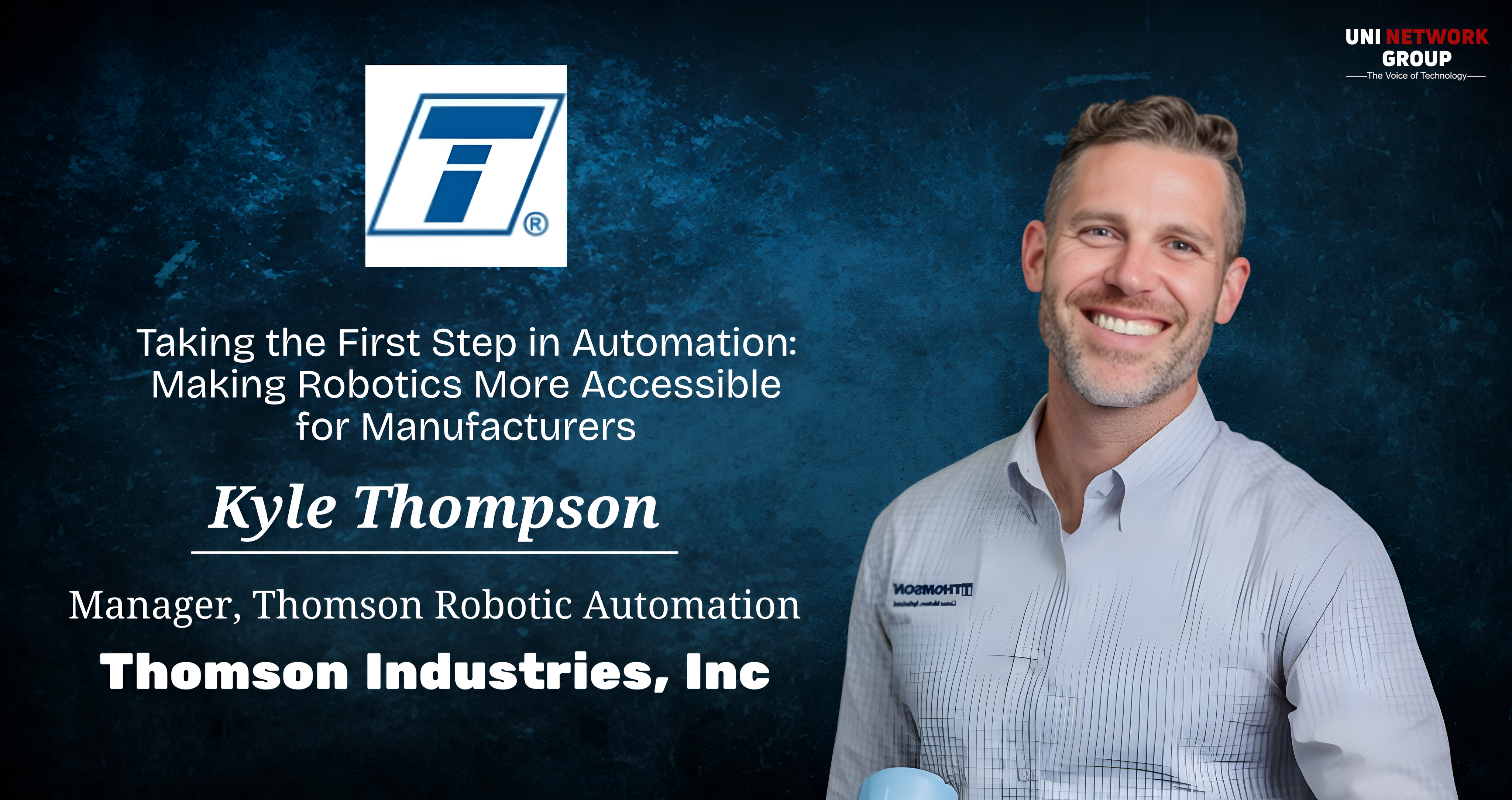
An Exclusive Interview with
Kyle Thompson , Manager,
Thomson Robotic Automation
KEY TAKEAWAYS
- AI-powered vision systems simplify robotics adoption, enabling flexible automation for diverse manufacturing environments and applications.
- Successful first automation projects build confidence, accelerate robotics adoption, and deliver measurable long-term operational improvements.
- Pre-engineered robotics solutions, software integration, and local support reduce deployment complexity and improve customer success.
- Hands-on automation education and industry collaboration prepare future talent to meet evolving smart manufacturing workforce demands.
As manufacturers across the globe accelerate their automation journeys, many are still taking their first steps toward robotics adoption. In this exclusive conversation with UNI Network Magazine, Kyle Thompson, Robotic Automation Manager at Thomson, part of Regal Rexnord, shares his perspective on the evolving robotics landscape, AI-driven automation, workforce development, and the future of smart manufacturing.
Q1. Can you introduce Thomson and tell us about your latest innovations?
Ans. At Thomson, our focus is on enhancing robot capabilities through our collaborative seventh-axis solutions. You might hear them referred to as linear tracks or rails, but essentially, we provide linear motion extensions for six-axis robots from all major robot manufacturers.
Our flagship product is our collaborative seventh axis, which allows robots to travel up to 10 meters, significantly expanding their working envelope for applications such as welding, machine tending, testing and inspection, and educational automation systems.

Q2. AI is transforming manufacturing rapidly. How do you see AI redefining robotics and industrial automation?
Ans. When people talk about the factory of the future, it's easy to imagine fully autonomous facilities. However, most manufacturers are still taking their first steps into automation.The exciting part is that AI breakthroughs - particularly in vision systems-are making automation more practical. Modern vision technologies can learn new recipes and adapt to low-volume, high-mix environments without extensive reprogramming.
These capabilities are opening up many new applications that previously weren't economically feasible to automate.For many manufacturers, AI is helping remove the barriers to implementing their very first robotic application.
Q3.Some industry leaders envision fully autonomous, human-free factories. What is your perspective on this vision?
Ans. I believe we're still some distance away from fully autonomous factories. Most companies today are focused on taking those first automation steps and deploying robots that work alongside people.The real opportunity lies in identifying applications that are relatively easy to automate and demonstrating success.
Once organizations successfully implement their first robotic project, they gain confidence and become more willing to automate increasingly complex tasks.What is making this journey easier is that robot manufacturers and ecosystem partners are now delivering pre-engineered solutions that are already 80 percent complete, allowing companies to adopt automation with far less complexity.
Q4. Which technologies are having the greatest impact on robotics today?
Ans. Advanced vision systems are probably having the biggest impact.Many of today's AI-enabled vision platforms can process variations, manage customization, and adapt to changing conditions without requiring constant human intervention or extensive reprogramming.
These technologies significantly expand the range of tasks that can be automated and improve return on investment for manufacturers.The combination of intelligent vision systems, end-effectors, and integrated robotics is creating entirely new automation possibilities.

Q5. How do you envision manufacturing plants evolving over the next five years?
Ans. I expect manufacturing facilities to continue adopting significantly more robotics across operations such as packaging, material handling, and production.As automation technologies become easier to deploy and ROI becomes more apparent, manufacturers will increasingly embrace lights-out manufacturing for second and third shifts while improving quality and consistency.Typically, once a company installs its first robot, automation adoption accelerates. It's almost like a snowball effect - the success of the first project encourages organizations to automate additional processes.
Q6. How is Thomson helping customers accelerate their automation journey?
Ans. One of our primary goals is to make robotics integration as simple as possible.We provide complete seventh-axis packages under a single part number, including motors, drives, gearheads, actuators, cable chains, and other supporting components.
Beyond hardware, we also provide software integrations that appear directly on robot teach pendants, allowing customers to deploy solutions more confidently.Additionally, we offer on-site training and support services, particularly for universities, laboratories, and organizations that may not have extensive machine-building experience. This hands-on support helps ensure customers have a successful first automation experience.
Q7. Collaboration has become critical across the automation ecosystem. How does Thomson approach partnerships?
Ans. At Thomson, we often say that we don't build the robot - we make the robot you buy perform better.Collaboration is central to our strategy. We work closely with all major robot manufacturers and participate in their automation ecosystems, ensuring both mechanical and software compatibility.
We're also always open to new collaborations. If customers require support for a robot platform we haven't previously integrated with, we've developed software tools that make establishing new connections relatively straightforward.
Q8. Automation adoption is global. What challenges do you encounter while serving international markets?
Ans. Automation is truly a global trend. Whether in North America, Europe, Japan, South Korea, or China, manufacturers are facing similar challenges - primarily ensuring that automation projects generate positive ROI.One of the biggest factors for success is local support. First-time robot users often have many questions, so providing engineering assistance - either remotely or in person is essential.
We also manufacture globally, producing the same products in North America, Europe, and China. This enables us to deliver solutions more economically while supporting customers locally.
Q9. There is often a gap between academia and industry needs. What should educational institutions focus on?
Ans. Providing students with hands-on, real-world automation experience is critical.We're seeing tremendous investments from trade schools and community colleges in robotics and automation training.
Educational platforms that allow students to work directly with robots, automation cells, and industrial equipment are preparing them much more effectively for future careers.Universities should continue investing in practical equipment and experiential learning so graduates are truly ready to tackle industrial automation projects from day one.
Q10. What message would you like to share with manufacturers beginning their automation journey?
Ans. While we often talk about fully automated factories, the reality is that most companies are still working on their first few automation projects.If you're exploring your first robotic application and trying to maximize your return on investment, start by having conversations, asking questions, and learning from industry experts. Automation doesn't have to be overwhelming.The first successful project often becomes the foundation for many more.
"Most manufacturers are still taking their first steps into automation. The key is making that first step easier, more accessible, and successful. Once organizations experience the value of robotics, the automation journey naturally accelerates."
 Editorial Desk







 Share your Details for subscribe