


The AI Shockwave Reshaping Work
Artificial intelligence is advancing at a pace that is forcing governments, companies, and professionals to rethink the future of employment. Some researchers believe the disruption could be unprecedented. AI safety researcher Roman Yampolskiy has warned that by 2030, up to 99% of workers could face unemployment if AI surpasses human capabilities in most tasks.
Other industry voices echo similar concerns. Dario Amodei, CEO of Anthropic, has suggested that half of entry-level white-collar jobs could disappear within five years. Meanwhile, Geoffrey Hinton, often referred to as the “Godfather of AI,” warns that even highly skilled knowledge workers may face automation pressures.
Unlike previous industrial revolutions that replaced physical labor, today’s AI systems are beginning to challenge human expertise in reasoning, analysis, and complex problem-solving.
The Rapid Evolution Toward Agentic AI
AI has progressed through several transformative phases over the past decade, each expanding its ability to perform increasingly complex work.
- Chatbots (2015–2021):
Early digital assistants such as Siri and Alexa could answer questions or follow predefined commands. While useful, these systems lacked autonomy and deep reasoning capabilities. - Generative AI (2022–2023):
The launch of models such as GPT-3.5, GPT-4, DALL·E, and Stable Diffusion marked a turning point. AI could now generate text, images, code, and design concepts, moving automation directly into knowledge work. - AI Agents (2024–2025):
The next phase introduced autonomous systems capable of linking multiple tasks together. AI agents can research topics, generate code, test outputs, write documentation, and even schedule meetings across digital platforms. - Agentic AI (Emerging Today):
Agentic AI represents a deeper level of autonomy. Instead of simply executing instructions, these systems pursue goals. They collaborate with other agents, adapt to dynamic environments, and continuously improve through feedback loops. In theory, a single agentic system could design a product, identify suppliers, simulate production, and coordinate logistics.
This shift – from responding to prompts to managing objectives – is what fuels predictions of large-scale workforce disruption.
Humans at a Critical Crossroads
Every technological revolution has reshaped the workforce. The steam engine created mechanical engineering, electricity created electrical engineering, and the digital revolution created software development.
However, the rise of Agentic AI introduces a unique challenge: machines that perform tasks previously considered uniquely human.
For engineers and knowledge workers, the implications are significant:
- Routine tasks are increasingly automated: drafting reports, debugging code, or performing structured analyses.
- Advanced problem-solving is evolving: AI agents can test thousands of design scenarios or simulations simultaneously.
- Human roles are shifting: from task execution toward direction, supervision, and system integration.
The future therefore presents two potential paths:
- Obsolescence: competing directly against faster and cheaper AI systems.
- Amplification: learning to collaborate with AI to achieve outcomes beyond human-only teams.
Rather than eliminating human expertise, Agentic AI may fundamentally redefine it.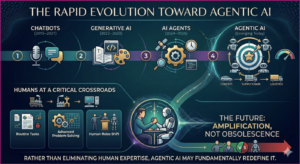
A Framework for Human – AI Collaboration
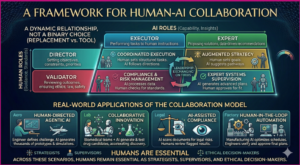
This article introduces the concept of the Agentic AI Future of Work, a framework that redefines how humans and agentic systems interact and collaborate.
This framework highlights a more dynamic relationship by examining two dimensions: the role of the human and the role of the AI.
Human roles:
- Director: setting objectives, constraints, and priorities.
- Validator: reviewing outcomes and ensuring ethical, legal, or safety standards.
AI roles:
- Executor: performing tasks according to human instructions.
- Expert: proposing solutions and making data-driven recommendations.
Combining these roles produces four collaboration modes where humans and AI exchange leadership depending on the situation.
Real-World Applications of the Collaboration Model
Elements of this framework are already emerging across industries.
- Human-Directed Agentic AI:
An aerospace engineer defines a design challenge while AI generates thousands of prototypes and simulations for evaluation. - Collaborative Innovation:
Biomedical research teams use AI to generate and test drug candidates, significantly accelerating discovery cycles. - AI-Assisted Compliance:
Regulatory specialists deploy AI to scan documents for legal risks while humans review flagged results. - Human-in-the-Loop Automation:
In advanced manufacturing, AI systems optimize production schedules while engineers verify and approve final plans.
Across these scenarios, humans remain essential as strategists, supervisors, and ethical decision-makers.
 From Scarcity to Technological Abundance
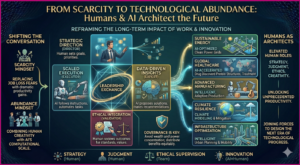
Much of the current conversation around AI focuses on job losses and economic disruption. However, the collaboration model suggests a different long-term outcome: abundance.
By combining human creativity with AI’s computational scale, productivity could increase dramatically. Small teams may soon accomplish what previously required entire organizations or industries.
This transformation could enable breakthroughs in critical areas such as:
- sustainable energy
- global healthcare
- advanced manufacturing
- climate resilience
- infrastructure optimization
However, the benefits of AI-driven abundance will depend heavily on governance. Without thoughtful policies and ethical oversight, the technology could also concentrate wealth and power.
 Humans as Architects of the AI Future
Predictions about AI – from mass unemployment to widespread economic transformation – are not inevitable outcomes. They are signals of how powerful the technology could become.
Agentic AI will reshape the nature of work, but it does not necessarily eliminate human relevance. Instead, it elevates the importance of human judgment, strategy, ethics, and creativity.
Engineers and knowledge workers who adapt to this new reality – working alongside AI rather than competing against it – may unlock levels of productivity and innovation never before possible.
The future of work will likely not belong to humans alone or machines alone, but to humans and AI collaborating to design the next era of technological progress.


 Share your Details for subscribe