


In the modern automotive landscape, the car you drive is rarely the product of a single, independent company. Instead, the industry is dominated by a handful of “mega-groups” that manage a diverse portfolio of brands – ranging from budget-friendly commuters to million-dollar supercars.
Understanding these corporate hierarchies reveals how the industry achieves the massive scale necessary to develop new technologies like electric drivetrains and autonomous driving.
👑 The “Big Six” Power Players
While there are dozens of recognizable badges on the road, most fall under the umbrella of these global giants:
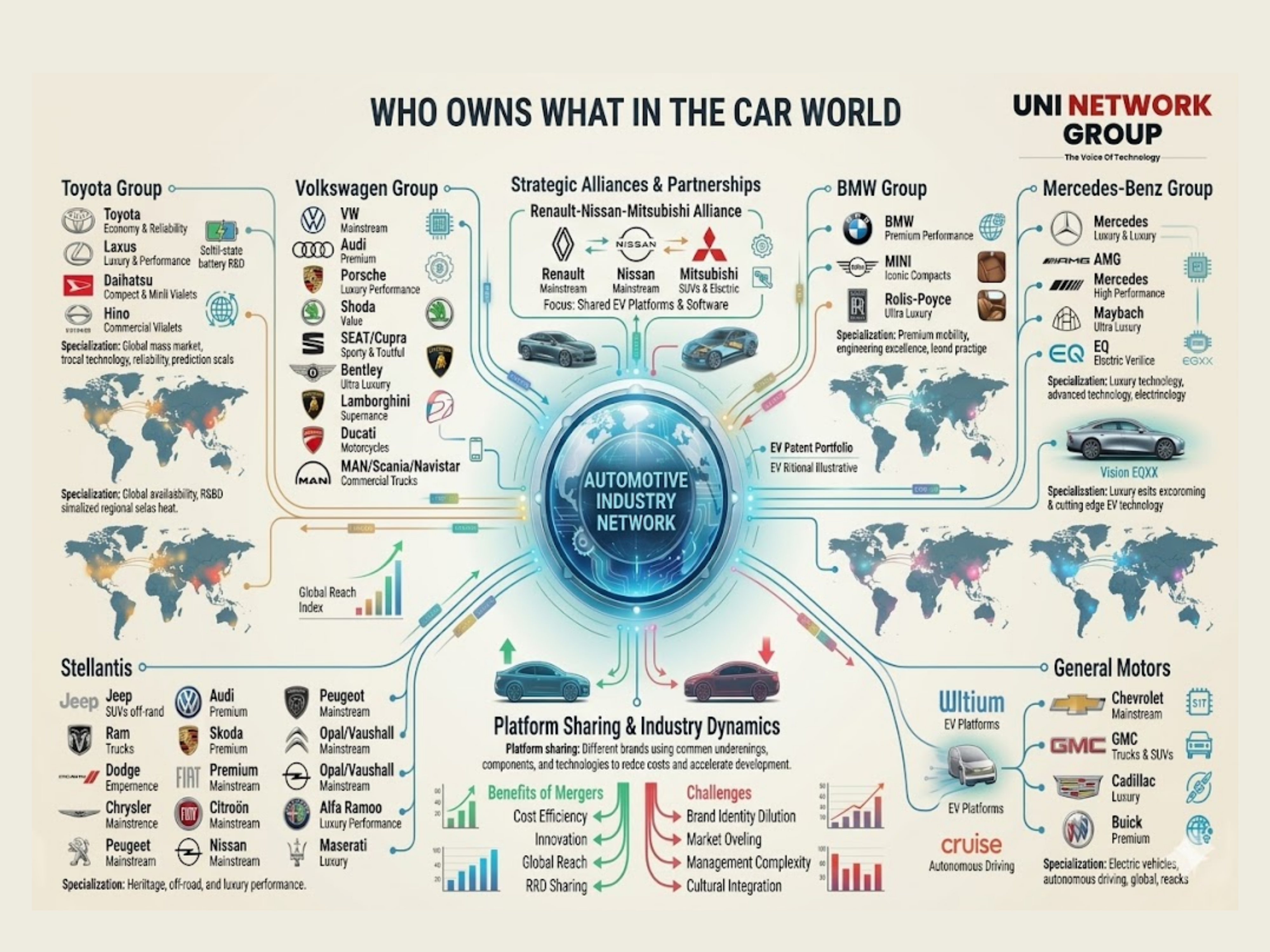
1. Toyota Group
The Japanese titan focuses on a reputation for bulletproof reliability and streamlined production.
- Toyota: The global leader in mass-market reliability.
- Lexus: The dedicated luxury division.
- Daihatsu: Specializing in small “kei” cars and compacts.
- Hino Motors: The group’s commercial arm for trucks and buses.
2. Volkswagen Group (VAG)
Perhaps the most diverse portfolio in the world, the German group covers every conceivable price point.
- Mainstream: Volkswagen, Škoda Auto (value-focused), and SEAT/Cupra (sporty).
- Premium & Luxury: Audi, Bentley, and Porsche.
- Exotics: Lamborghini and Ducati (motorcycles).
- Commercial: MAN SE and Navistar International.
 3. Stellantis
A massive conglomerate formed by the merger of PSA Group and Fiat Chrysler Automobiles (FCA), housing a mix of American, Italian, and French heritage.
- American Muscle & Utility: Jeep, Ram Trucks, Dodge, and Chrysler.
- European Heritage: Fiat, Peugeot, Citroën, and Opel/Vauxhall.
- Performance & Luxury: Alfa Romeo and Maserati.
4. BMW Group
The Bavarian giant maintains a tight focus on “The Ultimate Driving Machine” across three distinct tiers.
- BMW: The core performance-luxury brand.
- MINI: Premium compact cars with a cult following.
- Rolls-Royce Motor Cars: The absolute pinnacle of ultra-luxury.
5. Mercedes-Benz Group
Unlike VW, Mercedes-Benz focuses almost exclusively on the premium and luxury sectors.
- Mercedes-Benz: The core premium brand.
- Sub-Brands: AMG (high performance), Maybach (ultra-luxury), and EQ (dedicated electric vehicles).
6. General Motors (GM)
The backbone of the American auto industry, GM has streamlined its portfolio to focus on high-margin trucks and SUVs.
- Chevrolet: The high-volume mainstream brand.
- GMC: Professional-grade trucks and SUVs.
- Cadillac: The standard-bearer for American luxury.
- Buick: Positioned as a “premium” alternative between Chevy and Cadillac.
🤝 The Alliance Model: Collaboration Without Marriage
Not every partnership is an acquisition. The Renault–Nissan–Mitsubishi Alliance is the most famous example of cross-holding. While they remain separate corporate entities, they share:
- Platforms: The “skeletons” of the cars.
- Engines: Sharing the massive cost of R&D.
- Supply Chains: Buying parts in bulk to lower costs.
 ⚙️ Why Does This Matter?
The “Why” behind these conglomerates comes down to Platform Sharing. Developing a new vehicle platform costs billions of dollars. By owning multiple brands, a group can use the same chassis and engine for a “budget” car and a “luxury” car- simply changing the interior materials and exterior styling.
The Simple Takeaway: The next time you see a dozen different car logos in a parking lot, remember: they likely answer to the same boardroom. Consolidation allows these brands to survive in an era where the cost of innovation is higher than ever.

 Share your Details for subscribe