




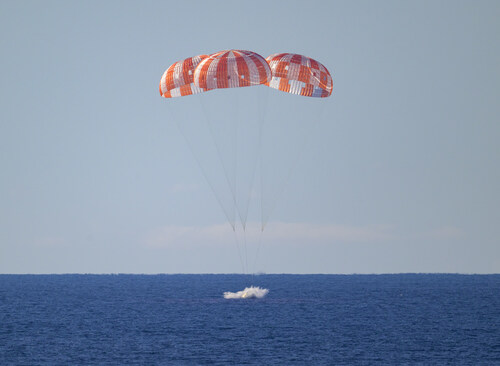
The Lockheed Martin-built Orion spacecraft has successfully completed the Artemis II mission, splashing down in the Pacific Ocean after traveling nearly 694,000 miles around the Moon. The mission, conducted under NASA’s Artemis program, marks the first crewed deep space flight in over five decades and a major step toward sustained lunar exploration.
The spacecraft carried a four-member international crew on a 10-day lunar journey, validating key systems required for future missions to the Moon and beyond.
Return to Deep Space Exploration
The successful completion of Artemis II represents a pivotal moment in human space exploration. The mission demonstrates the capability of the Orion spacecraft to safely transport astronauts beyond low-Earth orbit, a region no human has ventured beyond since the Apollo era.
Developed by NASA with Lockheed Martin as prime contractor, Orion is central to the Artemis program’s long-term objective of establishing sustainable lunar presence and preparing for future Mars exploration.
Mission Details: Lunar Flyby and Critical System Testing
During its 10-day mission, the Orion spacecraft executed a free-return trajectory around the Moon, traveling to a record distance of approximately 252,756 miles from Earth.
Key mission activities included:
- Testing of life support, navigation, propulsion, and communication systems
- Manual piloting evaluations in deep space conditions
- High-resolution imaging of the Moon’s far side
- Validation of integrated environmental control systems and avionics
The spacecraft endured extreme conditions during Earth re-entry, with heat shield temperatures reaching nearly 5,000°F before deploying its parachute system for a controlled descent into the Pacific Ocean.
Crew and Recovery Operations
The mission crew included astronauts Reid Wiseman, Victor Glover, Christina Koch, and Canadian Space Agency astronaut Jeremy Hansen. Following splashdown, recovery teams retrieved the capsule and transported the crew to the USS John P. Murtha for initial post-landing procedures.
The astronauts are scheduled for medical evaluations before returning to NASA’s Johnson Space Center in Houston.
Strategic Impact: Validating Future Lunar Missions
The success of the Orion spacecraft is a critical validation step for upcoming Artemis missions, including Artemis III and IV, which aim to demonstrate lunar landing operations and long-term human presence on the Moon.
By proving its deep space capabilities, Orion strengthens the technological foundation required for sustained lunar exploration and eventual human missions to Mars.
Industry Significance: Strengthening Space Collaboration
Built by Lockheed Martin in partnership with NASA, Orion represents a major advancement in crewed spacecraft design, integrating advanced avionics, life support systems, and thermal protection technologies.
The mission reinforces the growing role of public-private collaboration in deep space exploration and highlights the U.S.’s continued leadership in human spaceflight innovation.


 Share your Details for subscribe