Zebra Technologies has recognized Kaylie Rose with its Global Marketing Excellence Award, making her the first recipient of the honor in 2026. The award acknowledges her outstanding leadership and contributions to the company’s marketing initiatives, particularly during the North America Sales Kick Off and Channel Partner Summit. The recognition underscores the importance of strategic collaboration, innovative event experiences, and cross-functional…
A major leadership development unfolds as Larry Kellerman, Chief Power Officer of Fermi America, has been nominated to join the company’s Board of Directors by…
Clou, a BNEF Tier 1 energy storage system provider, showcased its latest innovations in energy storage at Solar & Storage Live UK 2025 in Birmingham. The centerpiece was the Aqua-C3.0 Pro liquid-cooled energy storage system, debuting in Europe for the first time, alongside multiple integrated energy storage solutions for commercial and industrial applications.
Growth in the UK Energy Storage Market
The UK energy storage sector is rapidly expanding due to clear policy frameworks, established electricity market mechanisms, and diverse revenue opportunities. While large-scale utility projects continue to rise, demand for commercial and industrial (C&I) energy storage is accelerating. Clou’s European debut addresses this growing need with advanced, large-capacity energy solutions.
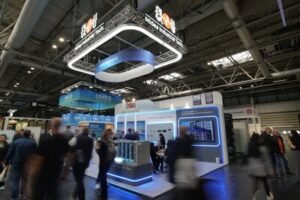
Clou’s Booth at Solar & Storage Live UK 2025
Operational Details: Aqua-C3.0 Pro Features
The Aqua-C3.0 Pro boasts over 600 Ah per cell and a total capacity of 6.88 MWh in a single enclosure. Key advancements include:
Direct liquid cooling to cells for higher efficiency and safety.
Patented Smart Scales and SiC String PCS balancing technology, achieving 92.3% RTE and boosting lifetime energy production by 4%.
CTR architecture for separated thermal and electrical paths and directional ventilation.
ThermoFlux 2.0 explosion-proof active ventilation system, developed with Midea Group, offering early warning, fire suppression, and explosion protection.
Simplified O&M, with reduced components, self-powered auxiliary systems, and remote monitoring to cut operational costs.
Economic Impact: Efficiency and Cost Reduction
By improving energy efficiency, reducing total cost of ownership by 10.63%, and simplifying maintenance, Clou’s Aqua-C3.0 Pro provides operators with lower operational expenses and longer system lifetimes. The modular 20-foot container design also enhances transport convenience and rapid deployment.
Strategic Significance: European Market Expansion
Clou’s showcase reflects its commitment to supporting Europe’s energy transition. Drawing on 30 years of electricity sector experience and successful global projects—from the U.S. to South America—Clou is integrating products into local electricity markets while leveraging local teams and service networks for efficient O&M support.
LanzaJet, Inc. and Kazmunaygas (KMG) have reached a major milestone in developing Kazakhstan’s first sustainable aviation fuel (SAF) project. The collaboration, announced during Climate Week NYC, moves into the Front-End Engineering and Design (FEED) phase following a successful joint feasibility study.
LanzaJet logo
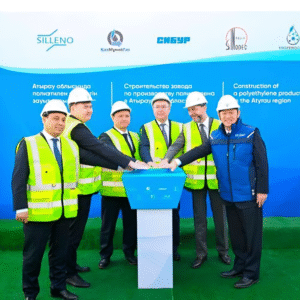
LanzaJet CEO Jimmy Samartzis addressed an audience including President Kassym-Jomart Tokayev of Kazakhstan and KMG President Askhat Khasenov. During Climate Week NYC, the two companies signed an agreement to advance SAF production, leveraging LanzaJet’s proprietary alcohol-to-jet (ATJ) technology. This partnership marks LanzaJet’s first deployment in the region.
Operational Details
The project has officially moved into the FEED phase, during which all technical and economic plans for the SAF plant’s construction will be finalized. This stage is crucial for ensuring the feasibility, efficiency, and sustainability of future operations.
Economic and Environmental Impact
Jimmy Samartzis highlighted the strategic importance of Kazakhstan’s industrial sectors, including agriculture, logistics, oil and gas, and aviation. The SAF project is expected to enhance low-carbon flying, boost economic development, and strengthen regional energy security.
Strategic Significance
KMG’s Askhat Khasenov emphasized that the project will support low-carbon development goals, introduce advanced technologies, and positively influence the biofuels market. The initiative is projected to meet Kazakhstan’s SAF demand, anticipated to reach 70,000 tons per year by 2030.
About LanzaJet
LanzaJet is a leading provider of alternative fuel technologies, specializing in ethanol-based ATJ solutions. Supported by partners including Airbus, British Airways, Microsoft, and Shell, LanzaJet accelerates sustainable aviation fuel production worldwide. The company has been recognized by TIME, MIT, and Platts for its contributions to climate tech and energy innovation.
Stegra has entered into two landmark agreements with Microsoft, aimed at advancing the adoption of near-zero emission steel. The first covers the supply of low-carbon steel for Microsoft’s datacenter projects, while the second introduces environmental attribute certificates (EACs), a first-of-its-kind mechanism in the steel industry designed to drive global demand for green steel.
Supply of Near-Zero Emission Steel
Stegra will deliver steel with up to 95% lower emissions than conventional production from its flagship plant under construction in Boden, Sweden. This steel will be supplied to Microsoft’s datacenter equipment suppliers, helping the tech giant reduce embodied carbon in its expanding datacenter footprint.
Henrik Henriksson, CEO of Stegra, emphasized the importance of collaboration: “Sustainable change calls for unconventional partnerships…to accelerate change in the steel industry.” Jennifer Weitzel, Microsoft’s Corporate VP of Engineering, Construction and Procurement, added that integrating low-emission steel is critical for decarbonizing infrastructure while maintaining hyperscale performance standards.
Environmental Attribute Certificates (EACs)
In addition to physical steel, Microsoft and Stegra signed an agreement for EACs, decoupling the green value from the physical product. While the steel itself is sold as conventional, the EACs allow Microsoft to claim the emissions reductions corresponding to the nearly zero-emission steel.
Melanie Nakagawa, Chief Sustainability Officer at Microsoft, noted: “When physical delivery isn’t yet feasible, EACs demonstrate that emissions reductions are possible in the value chain, signal demand, enable project financing, and accelerate global production.”
Driving Sustainable Steel Production
This innovative approach ensures no double-counting of emission reductions while promoting broader adoption of green steel. By separating the green value from physical steel, the partnership encourages larger volumes and expanded geographic availability of near-zero emission steel.
Henriksson highlighted the industry impact: “It’s impressive that Microsoft has chosen to team up with Stegra and put something completely new on the steel market, incentivizing bigger volumes and more locations for steel production with close to zero emissions.”








 Supply of Near-Zero Emission Steel
 Share your Details for subscribe